
WayATL: Wayfinding for the FIFA World Cup
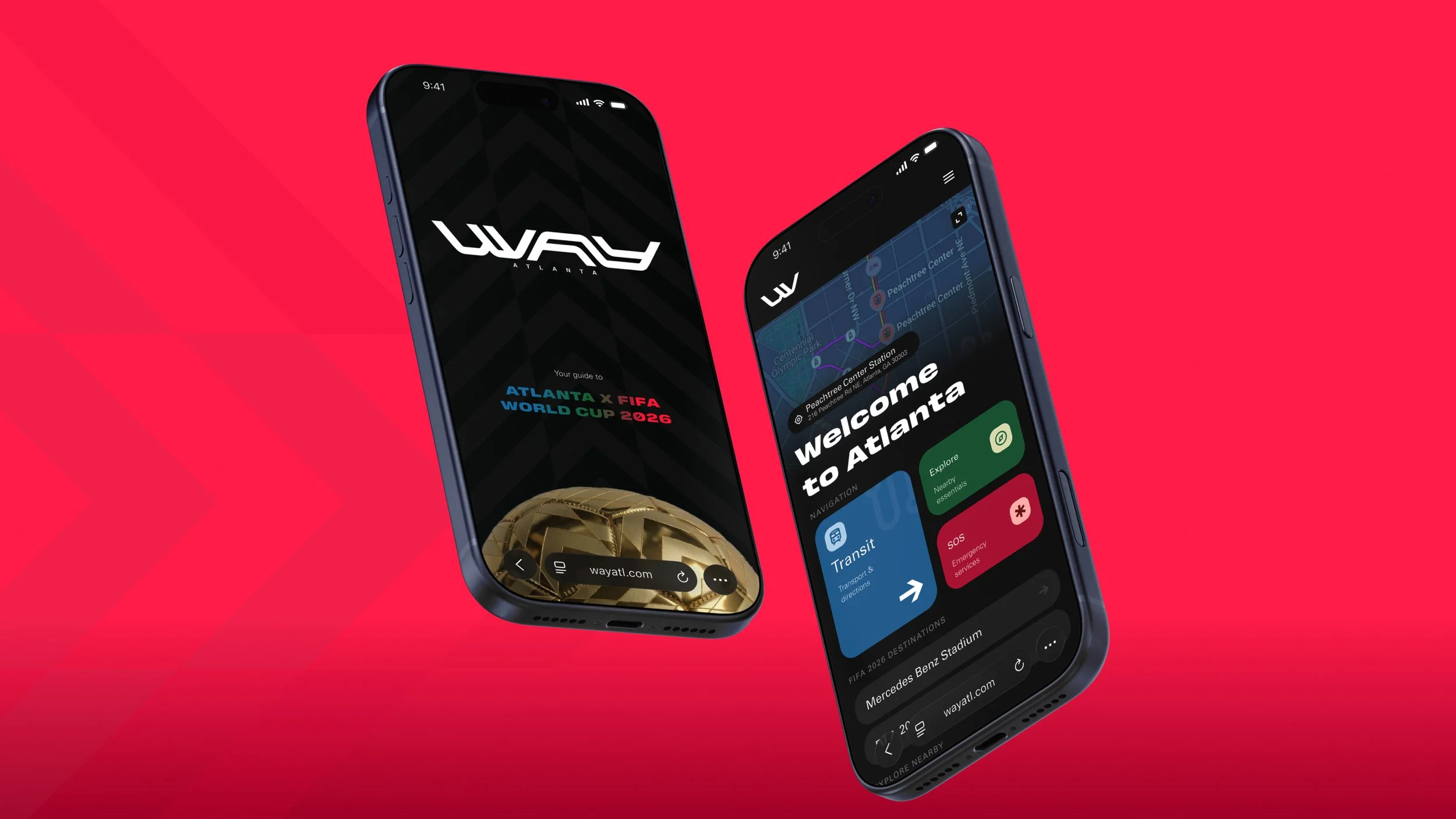
WayATL is a location-aware progressive web app built to help FIFA World Cup fans navigate the city during one of the largest events Atlanta has ever hosted. As Lead UX Designer, I led research and design for a wayfinding experience built for a multilingual, high-volume crowd operating under real safety and operational constraints.
Role
Lead UX Designer
Duration
10 weeks
Team
2
Toolkit
Figma, Adobe Suite, AI-assisted development
PROBLEM AND SCOPE
International and out-of-state fans will be visiting Atlanta for the FIFA 2026 World Cup.
8
World Cup matches hosted in Atlanta
Hundreds of thousands of international visitors will navigate an unfamiliar city in an unfamiliar language. Without clear, accessible wayfinding, the fan experience will face challenges.
The physical signage system created by our team guides visitors in English, with static text, once a fan is already close enough to read a sign. How do we reach fans even sooner than the perimeter of physical signage, before they ever see a sign?
300K+
expected unique spectators at matches
Problem Statement
Fans arriving in Atlanta for the World Cup are navigating a city most of them have never visited, often in a language other than English, with no single reliable source for transit, nearby essentials, or emergency information. Existing wayfinding, such as static signage and generic map apps, weren't built to close that gap at the exact moment a fan needs it: standing on an unfamiliar corner, unsure where to go next.
75%
of fans travelling from outside Georgia
How Might We Statement
How might we give a multilingual, first-time-in-Atlanta crowd instant access to the exact information they need, right where they're standing, without requiring an app download, a login, or any prior knowledge of the city?
OPPORTUNITY
The client-driven direction and constraints were already set.
We didn’t start from a blank page. Before research or ideation began, the direction was already set: a location-aware mobile web experience that activates the moment a fan scans a QR code or taps an NFC chip on the physical totems and signage already being installed across the city. No app to download, no login; A webpage that knows exactly where you're standing and gives you what you need from there.
This concept came from SCADpro studio's founding pitch. The proposal our professor brought to both the school and the Metro Atlanta Chamber to get this project greenlit in the first place was framed specifically around that concept from the start. By the time our team was brought on, the format wasn't something we were being asked to discover; it was the premise the client had already signed on to.
That's not the order the UX process usually runs in.
Typically, you don't land on a specific solution until well after discovery and ideation have narrowed the field. Here, research and ideation had a different job: not "what should we build," but "how do we build this well, and validate that it's actually the right call for the people who'll use it.”
Working inside a constraint like that is a real part of professional practice. Client-driven projects don't always hand you a blank slate. Sometimes, the format is decided before you're in the room, and part of the job is designing rigorously within that direction.
RESEARCH
Research Areas
User Research and Synthesis
User Journey and Persona Development
Event Facts and Statistics
Digital Accessibility and Ethical Urban Design
Backend Data Intelligence Gathering
Wayfinding and Mega Events Case Studies
Technology Feasibility and Implementation at Scale
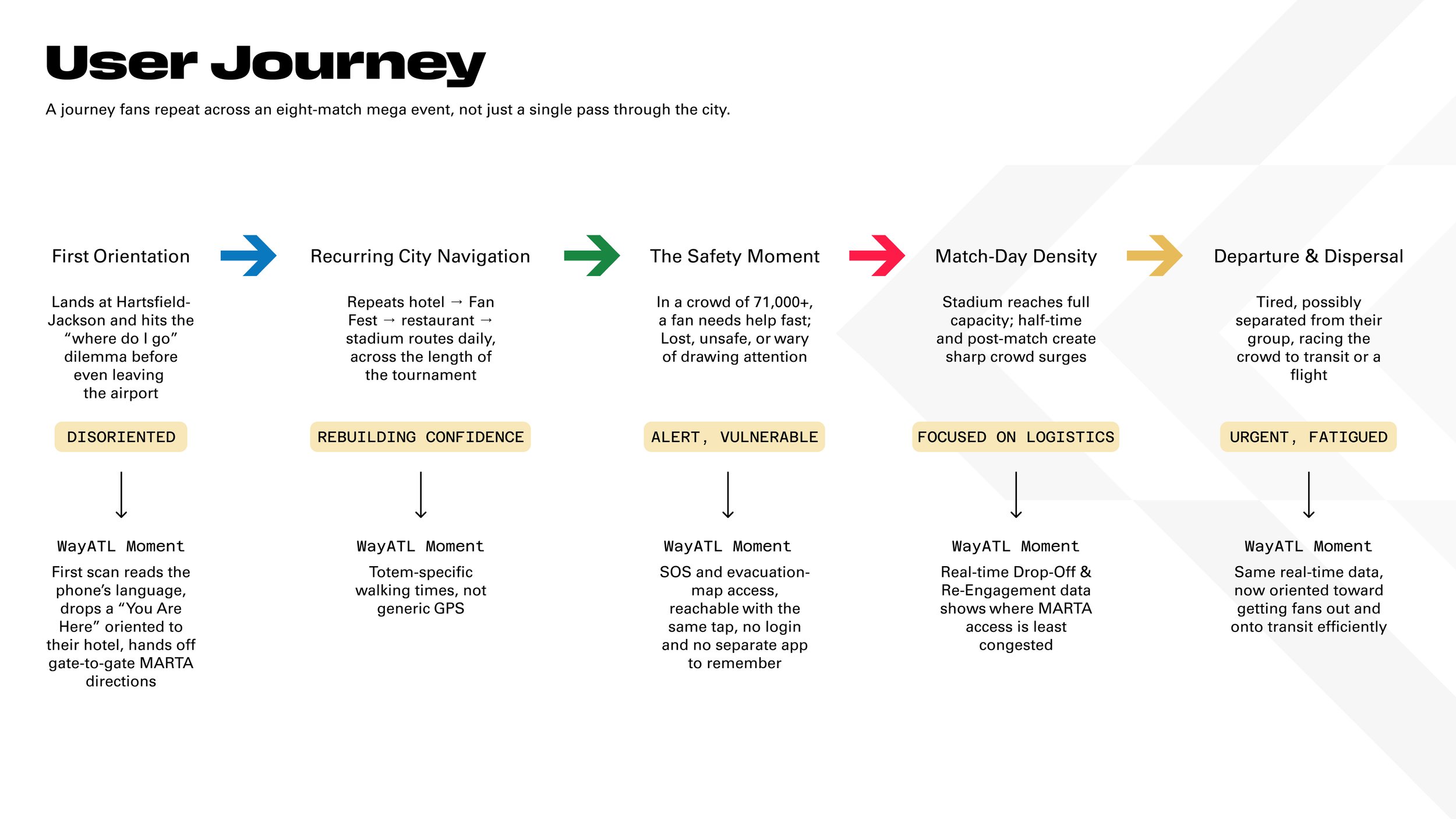
Persona Development
The First-Time International
Motivations: Experience "Southern Hospitality," follow their team, and find the best local food
Pain Points: Language barriers, fear of getting lost in a non-walkable city, and unpredictable MARTA schedules
The High-Stakes Pilgrim
Motivations: Express deep national pride, perform group rituals, and find social spaces
Pain Points: High sensitivity to extreme heat, requirement for group-coordinated movement, and legal/cultural constraints
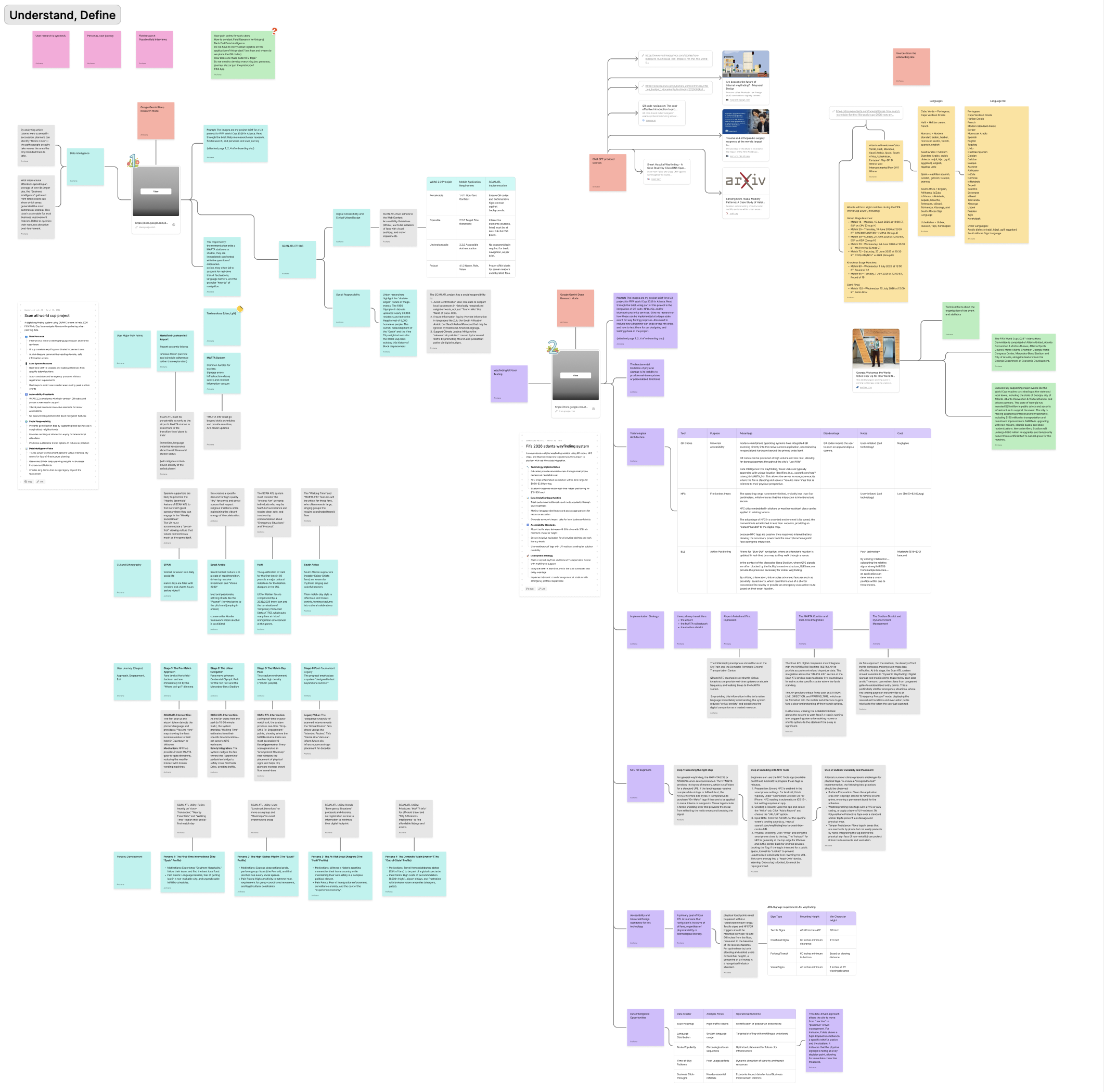
The At-Risk Local Diaspora
Motivations: Witness a historic sporting moment while maintaining safety in a complex political climate
Pain Points: Fear of immigration enforcement, surveillance anxiety, and the cost of the "experience economy"
The Domestic "Main Eventer"
Motivations: Travel from neighboring states (75% of fans) to be part of a global spectacle
Pain Points: High costs of accommodation, airport delays, and frustration with broken system amenities (chargers, gates)