

Archana
Kannan

UI/UX Designer

Where logic and instinct have to agree.

Get in touch
All work
UI/UXAI platform

LAYA

Private equity leadership intelligence

Laya is a private equity leadership intelligence platform that helps newly PE-backed executives get governance-ready in their first 100 days. When a PE firm buys a company, it runs exhaustive diligence on financials, markets and legal risk. Then it hands the CEO a deal book and expects them to perform at PE speed. Laya closes that gap with an advisory dashboard, a live governance risk map, a PE-specific learning path, a private workspace, and Counsel, an AI advisor that knows the deal.

Role
Lead UI/UX Designer
Context
SCAD BFA UX Design senior capstone
Team
1
Duration
8 weeks · 2026
Toolkit
Figma, Adobe Suite, AI-assisted development
Laptop on an orange armchair showing the LAYA landing page: The first 100 days have a rhythm. Laya teaches it to you.

01 — Problem

A hundred days, no map

Context

CEOs owned by Private Equity (PE) firms must master everything a great company CEO does while operating at a higher metabolic rate. A newcomer to PE also faces having limited access to insight about the road ahead, because there is so little specific guidance in print about the portfolio-company CEO role.

75%

of PE failures tied to CEO culture fit

90%

of PE firms use a 100-day plan

73%

of underperforming CEOs are replaced

Problem statement

Private equity firms conduct exhaustive due diligence on financials, markets, and legal risk, yet consistently fail to evaluate or prepare for the single greatest post-investment risk: whether the CEO can lead effectively under PE governance. The gap between what PE firms analyze before close and what they support after close is where value creation dies.

How might we

…design a leadership transition system that protects PE value creation by closing the governance gap between when a deal closes and when the CEO is truly equipped to execute?

Case studies

Two real-world PE transitions, one that failed and one that succeeded, show how much the outcome depends on what happens to leadership after the deal closes.

A Toys R Us shop-in-shop with Geoffrey the giraffe mascot among toy displays
Case study 01

Toys “R” Us

In 2005, Bain Capital, KKR and Vornado Realty Trust took Toys “R” Us private in a $6.6 billion leveraged buyout, just as Walmart, Target and Amazon were reshaping toy retail.

  • Financial doomThe deal loaded the company with more than $5 billion in debt from day one. Interest alone consumed hundreds of millions a year that should have funded stores, e-commerce and lower prices.
  • Debt obligationsStore reinvestment budgets were repeatedly cut to service the debt. Former executives later testified the company had the revenue to compete, but never the capital.
  • Paid either wayThe owners kept collecting millions in management and transaction fees, even as stores deteriorated.

The Las Vegas Sphere at night lit up with the Dell Technologies logo
Case study 02

Dell Technologies

In 2013, Michael Dell and Silver Lake took Dell private for $24.9 billion: Dell invested $4.2 billion for a 75% stake, Silver Lake $1.4 billion for 25%.

  • Complete visibilitySilver Lake’s operating partners supported management rather than replacing it, adding expertise in scaling, new markets and governance that complemented the founder’s vision.
  • An active, understood boardSilver Lake co-CEO Egon Durban joined the board, and the CEO knew exactly what that meant. Together they steered acquisitions including the roughly $67 billion EMC deal in 2016.
  • Massive ROIBy 2023, Silver Lake and Michael Dell had earned an estimated $70 billion, one of the most successful private equity turnarounds of all time.

Strategic drivers behind the scope

Who Laya is for, when it matters most, and why this moment needed a dedicated tool.

Target
PE-backed founder-CEOs at portfolio companies with an enterprise value of $50M–$250M (lower-middle to middle market)
Primary users
The founder-CEO, the installed CEO and the CXO team
Context
Post-close governance integration during the hold period, typically 3–7 years, with the first 100 days being make-or-break

Where momentum quietly breaks

01

Silent struggles

Despite the capital, the ambition and the accomplishments, newly PE-backed companies often find themselves off balance. Leadership is in disarray over expectations and miscommunication, and nobody knows who’s actually driving what.

02

Hidden sources of friction

Misaligned expectations, governance fog, priority whiplash, culture shock and timeline confusion are invisible culprits that sabotage post-close momentum.

03

The sponsor’s confidence spiral

The sponsor grows frustrated by a lack of urgency, missing strategic traction, unclear feedback and misunderstood reporting expectations. Add vague communication, PE culture shock and a poorly defined operating cadence, and a once high-performing management team starts to stall.

02 — Research

Inside the first 100 days

Primary research

  • Coffee chats and interviews with industry professionals
  • Mentors on the project came from companies including Allied Digital, McKinsey, Hitachi Vantara, Meta and Mekiki Partners
    • Weekly mentor reviews pressure-tested the direction, challenged assumptions and shaped each iteration

Secondary research areas

  • Industry scale
  • CEO non-fulfillment rate in PE
  • Where and why portfolio companies (portcos) struggle
  • Psychology of the PE transition
  • Pre- vs. post-investment comparison
  • What a VCP is, plus key terms, metrics and PE diction
  • Timeline of the 100-day window

Insight 01

It’s rarely competence. It’s context.

Exceptional leaders struggle because they’re decoding an unfamiliar governance model while running a company. Constant monitoring leaves no bandwidth for the strategy that justified the deal.

Insight 02

CEOs execute a plan they didn’t write.

The VCP is built before or at close, often without the CEO. As mentor Raman Narasimhan (Mekiki Partners) put it, this creates a structural gap.

Insight 03

The problem is growing, not stabilizing.

PE-backed companies discuss CEO succession at about half the rate of public companies, most succession is reactive, and a survey by AlixPartners shows misalignment worsening after 10 years.

Mentor perspective

In PE, the Value Creation Plan (VCP) is the execution engine. It is what ultimately drives returns. These returns are measured through MOIC (Multiple on Invested Capital), the value created, and IRR, which reflects how quickly that value is generated. The important nuance is this: the VCP is usually created before or at the time of investment, but the CEO is expected to execute it, often without being deeply involved in its formulation. This creates a structural gap.
Raman NarasimhanIndependent Director (IICA Certified)Risk Governance, Operational Resilience, Financial Crime & ForensicsMekiki Partners

Secondary research findings

Seven areas of desk research, from the size of the market to what happens day by day in the first 100 days. Pick a topic to explore the evidence.

Private equity is industrial in scale

$10.6TGlobal PE fund assetsRecord high in 2025
$2.1TGlobal PE deal value, 2025Up from $1.8T in 2024
11,808US portfolio companiesAll-time high by Q4 2024

Private equity is not a niche market. Global PE fund assets reached a record $10.6 trillion at the start of 2025, growing 17.8% in a single year, and US portfolio companies alone have grown nearly fourfold since 2018. More executives than ever are navigating the first 100 days of PE ownership without structured support, and the problem is compounding, not stabilizing.

View all citations (23)
  1. AlixPartners. “Replacing a Portfolio Company CEO Comes at a High Cost: Annual Private Equity Survey.” AlixPartners, May 2017.
  2. AlixPartners. “Culture Is Key to Success (and Failure) in Private Equity Deals.” AlixPartners, March 17, 2020.
  3. Alvarez & Marsal. “Inside the Critical First 100 Days for a Private Equity-Backed CEO.” Alvarez & Marsal, May 19, 2022.
  4. Bain & Company. Global Private Equity Report 2026. Reported via Morningstar PR Newswire, February 23, 2026.
  5. Bililies, Ted, Madalyn Miller, Jason McDannold, and Clark Perry. “Tenth Annual PE Leadership Survey: Leadership Under Pressure: Aligning Growth and Efficiency.” AlixPartners, March 25, 2025.
  6. Cherry Bekaert. “Private Equity Report: 2024 Trends & 2025 Outlook.” Cherry Bekaert, February 12, 2025.
  7. EBM Software. “The First 100 Days: Inside the Pressure Cooker of Post-Acquisition Life.” EBM Software, January 12, 2026.
  8. EBM Software. “The Hidden Weight of the First 100 Days: What Leaders Really Carry After Acquisition.” EBM Software, March 24, 2026.
  9. Headcount Coffee. “How Private Equity Destroyed Toys ‘R’ Us: The Real Story Behind the Bankruptcy.” Headcount Coffee, November 30, 2025.
  10. Heidrick & Struggles. “Private Equity Focus: A New Process for CEO Succession Planning.” Heidrick & Struggles, October 23, 2025.
  11. Heidrick & Struggles. “Closing the Leadership Gap in Private Equity: Practical Steps Private Equity Firms Should Take Now to Strengthen Their Portfolio Company Leadership.” Heidrick & Struggles, January 27, 2026.
  12. Kleinguetl, Edward, John Gabbert, Steven Sparks, Lisa Walkush, Kelly DePonte, Roberto Ferranti, and Andy Rice. “What Can Be Done in 100 Days?” Grant Thornton, October 2013.
  13. KPMG. “Global Private Equity Investment Hits Four-Year High in 2025 as Investors Focus on Top End Deals.” KPMG Pulse of Private Equity, January 23, 2026.
  14. Lisle, Kit. “PE Operator Orientation: Eliminate Friction in 100 Days.” The Operators, June 2, 2025.
  15. McKinsey & Company. “A Playbook for Newly Minted Private Equity Portfolio-Company CEOs.” McKinsey & Company, September 24, 2021.
  16. Ocorian. “Global Value of Private Assets Held in Funds Rises 15.4% to Another All-Time High of $14.9 Trillion.” Ocorian Global Asset Monitor, February 13, 2026.
  17. Private Equity Stakeholder Project. “KKR, Bain Capital, Vornado Repeatedly Rewarded Themselves for Adding Debt to Toys ‘R’ Us.” Private Equity Stakeholder Project, 2018.
  18. Private Equity Stakeholder Project. “Private Equity Behind 70% of Large U.S. Bankruptcies in the First Quarter of 2025.” April 25, 2025.
  19. Private Equity Stakeholder Project. “From Healthcare to Retail, Private Equity’s Failures Pile Up in Second Half of 2025.” December 8, 2025.
  20. Russell Reynolds Associates. “Dispelling Common CEO Myths: Six Lessons for Private Equity Leaders and Portfolio Company CEOs.” Russell Reynolds Associates, October 9, 2025.
  21. S&P Global Market Intelligence. US Private Equity-Backed Bankruptcy Data 2024. S&P Global, January 2025.
  22. Wall Street Oasis. “Private Equity Case Study: Dell Technologies.” Wall Street Oasis, April 4, 2024.
  23. Waveup. “Understanding MOIC in Private Equity.” October 21, 2024.

User personas

Three people who meet the same post-close governance gap from very different seats. Open any line to read more.

Black-and-white portrait of Elias, a grey-haired man in glasses working at a desk
Age
53
Archetype
The Captain
Location
Relocating (Seattle to Detroit)
Education
M.S. Aerospace Engineering (MIT), MBA (Stanford)
Family
Married (25 years); 2 children in university
Role
Founder and CEO, Thorne Aerospace

Elias Thorne

Founder-CEO · Thorne Aerospace · Backed by Meridian Capital

I know this business better than anyone alive. But I don’t know who I’m working for anymore, or what language they’re speaking.

Elias founded Thorne Aerospace 18 years ago and built it to $85M in enterprise value before accepting a buyout from Meridian Capital Partners, a mid-market PE firm. He remains as CEO under a 3-year earnout tied to EBITDA targets. He is still in the same office, with the same team, but everything about how he is governed has changed.

Values and goals
Preserve what he built

Elias spent 18 years building Thorne Aerospace. His deepest fear is watching PE operational pressure hollow it out. Protecting his people is a moral commitment, not a management priority.

Earn credibility at the board level

He wants to be seen as a strategic executive, not just the founder of a company that was acquired. Proving his value to Meridian Capital in the first 100 days is both a business requirement and a matter of identity.

Protect his earnout

A three-year EBITDA-linked earnout represents both financial security and validation. Missing targets doesn’t just cost him money, it signals failure.

Master the new operating model

Elias is driven by competence. Not knowing the rules of his own game is intolerable. His goal is to understand PE governance, financial language and value creation logic well enough to operate with the same confidence he had as a founder.

Build trust before influence

He knows he cannot lead effectively in this new environment until the right people genuinely trust him.

Frustrations
Governance fog

No clear map of decision rights. The ambiguity forces him to either ask basic questions that undermine his credibility, or guess and risk overstepping.

Language barrier with the sponsor

Terms like MOIC, EBITDA bridge, hold period thesis and working capital normalization are used in board meetings as if he already knows them. He nods along and decodes later.

Priority whiplash

What feels like a sensible 12-month initiative to him is treated as an urgent priority by the board. What he considers a crisis is sometimes met with calm indifference.

No onboarding was provided

The deal closed. Meridian celebrated. Then everyone went back to their day jobs and expected him to perform at PE speed immediately.
Identity displacement

He was the final authority for 18 years. Now he is one level in a hierarchy that has multiple layers above him, and those layers have opinions about his business.

Behaviors
Cross-references everything

Runs board communications through both digital tools and handwritten notes. Processes analytically and intuitively at the same time.

Listens before speaking in new rooms

In Meridian meetings, he has learned to observe tone, language and priority signals before committing to a position.

Maps power before acting

Identifies informal influence and engages it first.

Protects his senior team from PE friction

Deliberately absorbs board pressure before it reaches his direct reports, shielding the team from governance turbulence so they can keep executing.

Over-prepares for board calls

Arrives with pre-built narratives, variance explanations and contingency answers.

Private note-taker

Keeps a parallel private record of observations, decisions and political dynamics.

Attitudes and beliefs
Formal documentation is a formality

He believes the real operating system of any organization is its unwritten rules: who actually makes decisions, who has informal veto power, what gets approved without a meeting. He will always seek the real map, not the org chart.

Speed is the new currency

He has spent his career building deliberately. PE has compressed his decision horizon from years to quarters. He is uncomfortable with this but intellectually accepts it and is trying to rewire his instincts.

He earned the right to have opinions

Elias built an $85M company from nothing. He doesn’t take well to being managed or second-guessed on operational matters. He respects expertise but bristles at process for its own sake.

PE boards are not enemies, but not partners yet

He is pragmatic enough to know Meridian’s involvement can be valuable. But trust must be earned both ways. He is watching how the board behaves before deciding how open to be.

Asking for help is a sign of readiness, not weakness

In the founder world, self-sufficiency was survival. In the PE world, he is learning that seeking orientation is what sophisticated executives do.

Tools and environment
Devices
MacBook Pro 16", iPhone 15 Pro Max, iPad Pro 12.9"
Enterprise software
Bloomberg Terminal, SAP S/4HANA, Microsoft Excel, Salesforce, Slack, DocuSign
Work context
Minimalist executive office at Detroit HQ; frequent travel between Detroit and Seattle; board calls from his home office; works 6am–9pm most days
Information habits
Wall Street Journal (daily), Harvard Business Review, handwritten strategic notes, a parallel digital and physical workflow
Ideal solution

Features: Governance decision matrix, 100-day milestone tracker, AI advisor with full context, sequential learning modules, PE language lexicon, stakeholder influence map, private executive workspace, board prep scaffolding.

Attributes: Executive-grade density, mobile availability, confidence-forward tone, no gamification.

Ideal experience

Emotions: Oriented, trusted, competent, legitimate, in control, supported.
Benefits: Clarity on decision rights, PE language decoded, stakeholder intelligence.

Black-and-white portrait of Jia, a woman in glasses on a phone call while reading documents
Age
44
Archetype
The Parachutist
Location
Chicago, IL
Education
B.S. Industrial Engineering (UM–Ann Arbor), MBA (Kellogg)
Family
Married (17 years); 1 child in university
Role
CEO, Hartwell Medical Devices

Jia Lee

Installed CEO · Hartwell Medical Devices · Backed by Crestfield Equity Partners

I know exactly what the board wants. What I don’t know is whether anyone in this building will help me get there, or quietly wait for me to fail.

Jia is a three-time PE-placed CEO who knows the sponsor’s language fluently. What she doesn’t know is the company she’s been installed to lead. Brought in by Crestfield Equity Partners with a mandate to nearly double EBITDA in 36 months, she is managing a board she can read perfectly and a team that didn’t choose her and may not trust her yet.

Values and goals
Deliver the value creation plan, and fast

Jia was hired with a specific mandate: grow EBITDA from $12M to $22M in 36 months and position Hartwell for a strategic exit. She has done this before. She is here to execute, not explore.

Build trust before deploying authority

She has been parachuted in over people who have worked here for a decade. She knows that exercising authority before earning trust will create resistance.

Identify and retain the hidden performers

Every company has three or four people who quietly carry disproportionate institutional knowledge. Finding them in the first 30 days, before they test the market, is her highest-priority intelligence operation.

Separate the personal from the structural

Some resistance to her appointment is cultural and will dissolve with time. Some is structural and must be addressed decisively. She values being able to tell the two apart quickly.

Protect her reputation with the sponsor

Crestfield placed her. If Hartwell underperforms, it reflects on her track record in PE circles, a small world. Maintaining sponsor confidence is both a career imperative and a personal standard.

Frustrations
No company context at onboarding

Crestfield provided a deal book and a financial model. Nobody gave her a cultural map, a relationship guide or a briefing. She is spending her most critical relationship-building weeks gathering basic intelligence.

The board wants results before she has context

The tension between board timeline expectations and the operational reality of learning a new company is a source of constant friction.

Her PE experience reads as cold to a founder-culture team

She speaks in KPIs, frameworks and exit multiples because that is the language she was trained in. The team reads this as indifference to what they care about. She knows it’s happening and doesn’t know how to bridge it.

Every PE company is different

She has done three of these, and they are never the same. She wishes there were a smarter way to build a company-specific picture faster, so she can apply her experience sooner.

Behaviors
Runs leadership meetings immediately

Books 1:1s with every direct report and key informal leader in week one. Asks more than she answers. Records everything.

Separates board management from team management

Maintains two distinct communication modes: board-ready precision with Crestfield, conversational openness with the internal team.

Builds a shadow org map

Charts informal power structures in parallel with the official org chart.

Hunts quick wins in week two

Identifies two or three visible, near-term wins that signal competence to both the board and the team without disrupting what’s working.

Holds her VCP close until week four

Refuses to share her value creation plan draft until she has enough company context to make it credible, and resists board pressure to produce it earlier.

Attitudes and beliefs
Culture is data, not sentiment

She reads culture analytically. Meeting energy, response times, what gets volunteered vs. withheld: these are signals about where resistance, momentum and loyalty live.

The first 30 days are observational, not executive

She believes CEOs who arrive and immediately restructure destroy institutional knowledge. She spends the first month listening, mapping and building a picture before making structural moves.

Grief is a legitimate organizational response

Teams mourn leaders, and the former CEO may have been beloved. She doesn’t compete with that legacy. She acknowledges it and builds alongside it.

PE experience is both an asset and a liability

Her fluency in PE governance makes her effective with the board, but it can make her seem cold to a team that valued the founder’s warmth. She actively manages that perception gap.

Speed and thoroughness are not opposites

Moving fast on wrong information costs more than taking two extra days to get the picture right. She is fast because she is disciplined, not because she is reckless.

Tools and environment
Devices
MacBook Air 15", iPhone 15 Pro, AirPods Pro
Enterprise software
Salesforce, Microsoft 365, Notion (personal ops), Zoom and Teams, LinkedIn Sales Navigator, Carta (cap table)
Work context
No permanent office, desks in the company space; frequent flights between Chicago and client sites; works from airport lounges and hotel rooms; rarely at a desk for more than 90 minutes
Information habits
Deal memos and board packs, PE industry podcasts on the commute, Harvard Business Review, PitchBook for market context
Ideal solution

Features: Company cultural onboarding layer, VCP builder with context inputs, AI advisor with institutional memory, stakeholder trust tracker, board and team communication templates.

Attributes: Adaptive to experience level, fast to load and fast to act, relationship-first framing, repeatable across engagements and contexts.

Ideal experience

Emotions: Informed, credible, efficient, aligned, ahead of the curve, respected and not just obeyed.

Benefits: Company intelligence on demand, VCP scaffolding built for her context, stakeholder engagement prompts.

Black-and-white portrait of Kavitha, a woman in glasses with an earbud typing on a laptop
Age
40
Archetype
The Promoted Insider
Location
Bengaluru → Austin, TX (relocated)
Education
B.Com, Christ University, Bengaluru; CA (India); CFA Charterholder
Family
Married (9 years); 1 toddler
Role
CFO, Vantis Health Technologies

Kavitha Rajan

First-time CFO · Vantis Health Technologies · Backed by Harlow Growth Partners

I have spent 12 years becoming exceptional at finance. Nobody told me that a PE acquisition would require me to become a different kind of executive overnight.

Kavitha joined Vantis Health Technologies four years ago as Director of Finance and rapidly became the operational backbone of the company’s financial function. When Harlow Growth Partners completed their acquisition of Vantis, the outgoing CFO took a role at another firm, and Kavitha was promoted into the seat with 48 hours’ notice.

Values and goals
Prove the promotion was deserved, not circumstantial

She knows the timing of her elevation had as much to do with the CFO’s departure as with her own readiness. She is determined to make that irrelevant and perform beyond the expected level.

Build a finance function fit for PE oversight

She inherited a competent but founder-era finance team built for quarterly reviews, not monthly PE reporting packages. Rebuilding its cadence, tooling and output without losing the people she depends on is her most urgent structural goal.

Become a trusted voice in the boardroom

She has spent her career in the room next to the boardroom. She wants the kind of credibility that makes a board trust a CFO’s numbers without demanding a recut.

Protect her team through the acceleration

3 of her 4 senior finance staff have never worked under PE ownership. She wants to get them through the transition without burnout, departures or errors that reach the board.

Own the CFO role, not just perform it

Her long-term goal is to develop the strategic instincts, governance fluency and executive presence that make her a genuine peer to the CEO and the board, not just a technically excellent subordinate.

Frustrations
Promoted with 48 hours’ notice and zero handover

The outgoing CFO left within a week of the acquisition close. There was no onboarding. She inherited a role, a team and a set of live deliverables with no context.

Expected to know PE reporting formats she has never seen

Every format is new, and she is expected to produce them at board standard from day one.

Her background adds friction to prove

She is the only person in the boardroom who relocated internationally and whose first professional training was in a non-US system. She feels the extra weight of demonstrating competence at a higher resolution.

Her team is running at a cadence it wasn’t built for

Founder-era processes are straining under monthly PE reporting.

She can’t tell board confidence from board tolerance

She can’t tell whether the board genuinely trusts her work or is patiently waiting for her to grow into the role.

Behaviors
Arrives first, stays latest

Before every board pack deadline she runs her numbers twice, asks what question each number will generate and prepares.

Documents every new process in real time

Every PE reporting format she meets for the first time is immediately documented as a replicable process.

Seeks patterns across board interactions

After every board touchpoint she writes a private debrief.

Builds financial narratives, not just models

A flawless model without a clear narrative generates more board anxiety than a simpler model that tells a coherent story.

Protects her team from unfiltered board pressure

She absorbs board pressure and translates it into clear tasks for her team.

Uses her international background as an asset

She reads the boardroom with the attentiveness she developed crossing professional cultures, and adapts accordingly.

Attitudes and beliefs
Competence is the only currency that transfers

Her professional identity is built on the quality of her work. If the output is exceptional, credibility will follow, and nothing else substitutes for it.

PE is a system, and systems can be learned

She isn’t intimidated by PE governance, just frustrated by the lack of a structured way to learn it. She treats the transition as an engineering problem. She just needs the manual.

Transparency with the CEO builds everything

She refuses to manage up by filtering bad news. A CEO deciding on accurate information always beats the illusion of stability.

Cultural fluency is a professional skill

Having relocated from Bengaluru to Austin, she code-switches between professional cultures with precision, and treats PE governance as a new language to master, not a barrier.

Tools and environment
Devices
Lenovo ThinkPad X1 Carbon, Samsung Galaxy S24, dual monitor setup, iPad Mini
Enterprise software
NetSuite ERP, Microsoft Excel, Adaptive Insights, Tableau, Workiva, DocuSign
Work context
Private office at Austin HQ; arrives by 7am and leaves after 7pm; deep work before meetings begin; board prep the night before; infrequent travel
Information habits
CFO Dive and CFO Magazine, ICAI and CFA Institute publications, annotated board packs, a colour-coded Excel documentation system, WhatsApp to stay connected with family in Bengaluru
Ideal solution

Features: PE CFO learning track, AI financial advisor with PE context, finance team readiness tools, annotated reporting templates, board signal tracker, PE financial lexicon.

Attributes: Practical over conceptual, desktop-first for deep work, private by design, confidence-forward tone.

Ideal experience

Emotions: Capable, anchored, visible, ahead of the problem, supported without being exposed, proud.

Benefits: PE reporting fluency, a fast and discreet sanity-check resource, a map of what board confidence looks like.

User journey mapping

Each persona’s path through six phases, from the weeks before close to life after day 100, with where Laya steps in at every stage.

Emotional arc across the 100-day transition
  • Jia Lee
  • Elias Thorne
  • Kavitha Rajan
LAYA onboarding
  1. Phase 1Pre-closeWeeks −2 to 0
  2. Phase 2ArrivalDays 1–7
  3. Phase 3DisorientationDays 8–30
  4. Phase 4InflectionDays 31–60
  5. Phase 5StabilizationDays 61–100
  6. Phase 6New rhythmDay 100+

Founder-CEO · Thorne Aerospace · Backed by Meridian Capital

StagePhase 1Pre-closeWeeks −2 to 0Phase 2ArrivalDays 1–7Phase 3DisorientationDays 8–30Phase 4InflectionDays 31–60Phase 5StabilizationDays 61–100Phase 6New rhythmDay 100+
Actions
  • Signs legal agreements
  • Briefs senior team personally
  • Final founder announcements
  • Attends first board meeting
  • Receives deal documents
  • Meets operating partner
  • Produces first PE reports
  • Decodes PE language in meetings
  • Makes governance guesses
  • Absorbs team anxiety
  • Delivers first board presentation
  • Makes talent retain/exit calls
  • Aligns VCP with Meridian
  • Prepares 100-day review
  • Settles reporting cadence
  • Begins to lead, not just react
  • Operates with PE fluency
  • Leads board calls confidently
  • Drives VCP proactively
Thoughts

“I built this. Now I have to prove it was worth it.”

“Half the words in that board meeting meant nothing to me.”

“I’m nodding through meetings I don’t fully understand. Is this what everyone does?”

“I think I know what they want. But I’m not sure I’m saying it in their language.”

“I’m starting to see the pattern. Still behind, but I can see the path.”

“I know who to call, what to say, and what they care about. I’m leading again.”

Pain points
  • Identity loss begins
  • No PE orientation provided
  • PE language barrier hits immediately
  • No decision-rights briefing
  • Governance fog peaks
  • Reporting formats unfamiliar
  • Priority whiplash from board
  • Board call creates peak anxiety
  • Talent decisions without a PE frame
  • Earnout pressure mounts
  • 100-day review looming
  • Risk of complacency post-review
Solutions for LAYA
  • Profile & deal intake
  • Module 01 unlocks
  • PE lexicon activated
  • Governance matrix setup
  • Stakeholder map seeded
  • AI daily check-ins
  • Priority tracker live
  • Module 02 unlocks
  • Board prep scaffolding
  • VCP builder activated
  • Modules 03–04 unlock
  • 100-day review framework
  • Module 05 unlocks
  • AI narrative assist
  • Ongoing AI advisory
  • Stakeholder cadence
  • VCP milestone reviews

Installed CEO · Hartwell Medical Devices · Backed by Crestfield Equity Partners

StagePhase 1Pre-closeWeeks −2 to 0Phase 2ArrivalDays 1–7Phase 3DisorientationDays 8–30Phase 4InflectionDays 31–60Phase 5StabilizationDays 61–100Phase 6New rhythmDay 100+
Actions
  • Reviews deal book and VCP mandate
  • Researches leadership team history
  • Plans listening tour agenda
  • Delivers Day 1 all-hands address
  • Launches 1:1 listening tour
  • Starts mapping informal power
  • Identifies hidden performers
  • Spots cultural resistance patterns
  • Builds company intelligence
  • Resists early board VCP pressure
  • Drafts company-informed VCP
  • Socializes decisions before announcing
  • Makes first structural calls
  • Quick wins visible to team and board
  • Trust signals starting to shift
  • Performance metrics tracking live
  • Recognized as the company’s CEO
  • Drives exit-readiness narrative
Thoughts

“I know the playbook. The question is whether this company will let me run it.”

“They’re polite. But nobody’s actually helping me yet.”

“I can’t tell who is genuinely aligned and who is performing alignment.”

“The plan is solid. The question is execution with people who still miss the last CEO.”

“A few people are coming to me before they have to. That’s the signal I needed.”

“This is mine now. The team knows it too.”

Pain points
  • No company intelligence provided
  • Flying blind on team dynamics
  • Team grief for prior leader
  • Performing confidence under scrutiny
  • Can’t distinguish loyalty from deference
  • Board VCP pressure too early
  • First decisions watched closely
  • PE tone alienating founder culture
  • Key performers still evaluating exit
  • Risk of VCP drift post-stability
Solutions for LAYA
  • Cultural onboarding intake
  • Stakeholder map pre-seeded
  • Listening tour framework
  • Shadow org map builder
  • Alignment vs. deference tracker
  • Quick wins identification tool
  • VCP builder (company-informed)
  • Decision socialization prompts
  • Trust signal tracking
  • Retention risk alerts
  • AI narrative assist
  • Exit narrative scaffolding
  • AI ongoing advisory

First-time CFO · Vantis Health Technologies · Backed by Harlow Growth Partners

StagePhase 1Pre-closeWeeks −2 to 0Phase 2ArrivalDays 1–7Phase 3DisorientationDays 8–30Phase 4InflectionDays 31–60Phase 5StabilizationDays 61–100Phase 6New rhythmDay 100+
Actions
  • Receives CFO promotion with 48 hours’ notice
  • Reads deal model for the first time
  • Googles PE reporting formats privately
  • First board finance review
  • Asked for a 13-week forecast immediately
  • No handover from outgoing CFO
  • Produces PE reports from scratch
  • Manages team anxiety quietly
  • Starts a private PE learning log
  • Calls home to Bengaluru for grounding
  • Close cycle shortened to 7 days
  • Builds first EBITDA bridge
  • Board follow-up question answered well
  • Covenant compliance routine settles
  • 100-day financial summary produced
  • Begins coaching finance team on PE
  • PE CFO role fully owned
  • Trusted independently by the board
  • Finance team PE-fluent
Thoughts

“I’ve earned this. I just have to figure out what it actually requires, and fast.”

“They want a 13-week forecast. I have never made one. I need to solve this tonight.”

“I can’t tell if my work meets their standard. The silence is its own kind of pressure. And my son asked why I’m never home for dinner.”

“The board asked a follow-up and I answered it cleanly. First time I’ve felt ahead of the problem.”

“I know what good looks like now. I can see what I’m building toward.”

“I am a PE CFO. That’s not a stretch anymore, it’s just accurate.”

Pain points
  • Promoted with no handover
  • Accountability before readiness
  • Unknown PE format expectations
  • No peer to sanity-check against
  • Calibrating in silence (no feedback)
  • Finance close cycle too slow
  • Parenting pressure compounds
  • Excessive rework from uncertainty
  • Two senior staff updating CVs
  • Finance team burnout risk
  • No extended family support in Austin
  • Risk of skill plateau without a growth path
Solutions for LAYA
  • CFO learning track activated
  • PE report templates provided
  • 13-week forecast template + guide
  • AI as late-night sanity check
  • Board signal tracker begins
  • PE lexicon activated
  • Finance team resource pack
  • EBITDA bridge builder
  • Covenant compliance checklist
  • Team coaching resources
  • 100-day summary template
  • Advanced PE CFO modules
  • AI ongoing advisory

Most PE-backed CEOs don’t make it to exit

70+%of PE-backed CEOs are replacedDuring an average hold period of 5.5–6 years
55%of CEO turnover is unplannedAt the instigation of investors
41%of PE execs emphasize senior portco leadership challengesQuality, retention, continuity
AlixPartners · 10th annual survey · March 2025

A survey of 161 PE managing directors and 200 portfolio company executives finds serious misalignment between PE firms and portcos, heightened leadership pressure and a growing role for human capital partners. Now in its 10th year, it shows the problem worsening, not improving.

Heidrick & Struggles · January 2026

PE-backed companies discuss CEO succession planning at roughly half the rate of public companies, and most succession is reactive, not planned. That compounds the onboarding gap: there is no standardized, proactive system for preparing the CEO before or after the deal closes.

Where and why portfolio companies struggle

2xthe rate at which PE-backed companies defaultCompared to non-PE-owned companies
110PE-backed US bankruptcies in 2024Highest annual total on record
7 in 10major bankruptcies were PE-backedQ1 2025, though PE is only 6.5% of the US economy
KKR + Bain Capital · 2005–2017
Toys “R” Us

The CEO had no visibility into how $5B in LBO debt constrained every investment decision, and couldn’t reinvest in e-commerce or stores. The clearest case of a governance gap costing a company its future.

Silver Lake Partners · 2013–2018
Dell Technologies

Michael Dell co-authored the value creation plan with complete visibility into PE expectations from day one. Result: a $70B return and the most successful PE turnaround on record.

Vista Equity Partners · 2013–2016
Accruent

The founder-CEO initially felt oppressed by board involvement. Once a shared “banker book” was created at close, orientation followed, the playbook shock resolved, and the company exited successfully to Genstar Capital.

It’s the cognitive cost, not competence

The failure of PE-backed executives is rarely about competence. It’s about the cognitive and psychological cost of navigating an unfamiliar governance model while running a company. Three research-backed phenomena explain why even exceptional leaders struggle.

Role incongruence

A leader’s self-concept clashes with new role expectations. The “neutral zone,” when the old identity has been shed but the new one hasn’t formed, is where most PE-backed CEOs spend their first 100 days.

EBM Software · The Hidden Weight of the First 100 Days, 2026
Cognitive overload

Decoding PE terminology, producing unfamiliar financial reports, managing the board and leading a disoriented team at once leaves no bandwidth for the strategy that justified the deal. Constant monitoring creates what researchers call “cognitive reservation.”

Imposter syndrome at elevation

A newly elevated leader may struggle when their self-concept clashes with new role expectations. Often the gap is context, not competence: meeting PE-specific formats for the first time, at full professional accountability.

Exhaustive before close, absent after

Pre-investment
Exhaustive · Structured · Documented
  • Financial modeling & scenarios
  • Legal due diligence
  • Market & competitive analysis
  • Management assessment
  • Investment thesis development
  • Value creation plan drafted
  • Deal structure & debt design
  • Covenant terms & compliance
Post-investment
Reactive · Unstructured · Largely absent
  • Basic deal document handover
  • Operating partner introduction
The orientation gap
  • PE language & lexicon orientation
  • Decision rights communication
  • Stakeholder mapping & intelligence
  • VCP translation for the CEO
  • Board communication guidance
  • Lender relationship protocols
  • Governance decision support

The mandate every CEO inherits on day 1

Value creation plan (VCP) · Bain & Company Global Private Equity Report 2026

The structured blueprint PE firms use to grow a portfolio company’s enterprise value over the hold period, combining financial targets, operational initiatives, talent strategy and governance around the investment thesis. The CEO is expected to execute it, even if they didn’t help build it. Today’s deals need 10–12% average annual EBITDA growth to hit a 2.5× MOIC target, double the 5% that was enough in the prior decade.

EBITDAEarnings before interest, taxes, depreciation & amortization

The primary measure of company value in PE. Purchase price, exit value, earnout and KPIs are all expressed as a multiple of EBITDA. Growing it is the CEO’s central mandate.

Value = EBITDA × exit multiple
MOICMultiple on invested capital

How many times the PE firm has multiplied its original investment. A 2.5× MOIC means the firm returned two and a half times its capital. Most buyout funds target 2.5× or higher.

MOIC = exit value ÷ capital
IRRInternal rate of return

The annualized return on investment. Top-quartile PE funds target 20–25% IRR. Highly sensitive to timing: a 3× MOIC over 4 years gives ~26% IRR; over 7 years, just ~17%.

3× in 4 yrs ≈ 26% IRR
EarnoutPerformance-linked deferred payment

A portion of the acquisition price paid to the founder only if the company hits post-close financial targets. It’s how PE firms align the founder’s incentives with the investment thesis.

For example, $20M at risk

Three phases, three board questions

  1. Days 1–30Listen, orient, stabilize

    Board asks“Do they understand what they walked into?”

    Expected deliverables
    • Board relationships established
    • Baseline financials confirmed
    • Team assessed, not yet restructured
    • Investment thesis understood in their own words
    • Cash and customer risks stabilized
    Where CEOs slip
    • Acting before listening
    • Going silent on the board
    • Not yet understanding debt covenants
  2. Days 31–60Act, build, align

    Board asks“Can they execute at PE speed?”

    Expected deliverables
    • First board presentation delivered
    • VCP draft in progress
    • Talent decisions begun
    • Reporting cadence live and reliable
    • Quick wins launched and visible
    Where CEOs slip
    • A generic VCP that misses the thesis
    • Delaying talent decisions out of politeness
    • Overstepping decision rights
  3. Days 61–100Scale, prove, own

    Board asks“Do we have the right CEO?”

    Expected deliverables
    • 100-day review delivered
    • VCP fully internalized and defended
    • First lender reporting cycle complete
    • A-team in place
    • Leading indicators moving in the right direction
    Where CEOs slip
    • A 100-day review that sounds defensive
    • Fatigue causing permanent reaction mode
    • No early wins, so the board begins questioning

03 — Ideation

Designing for trust

Process

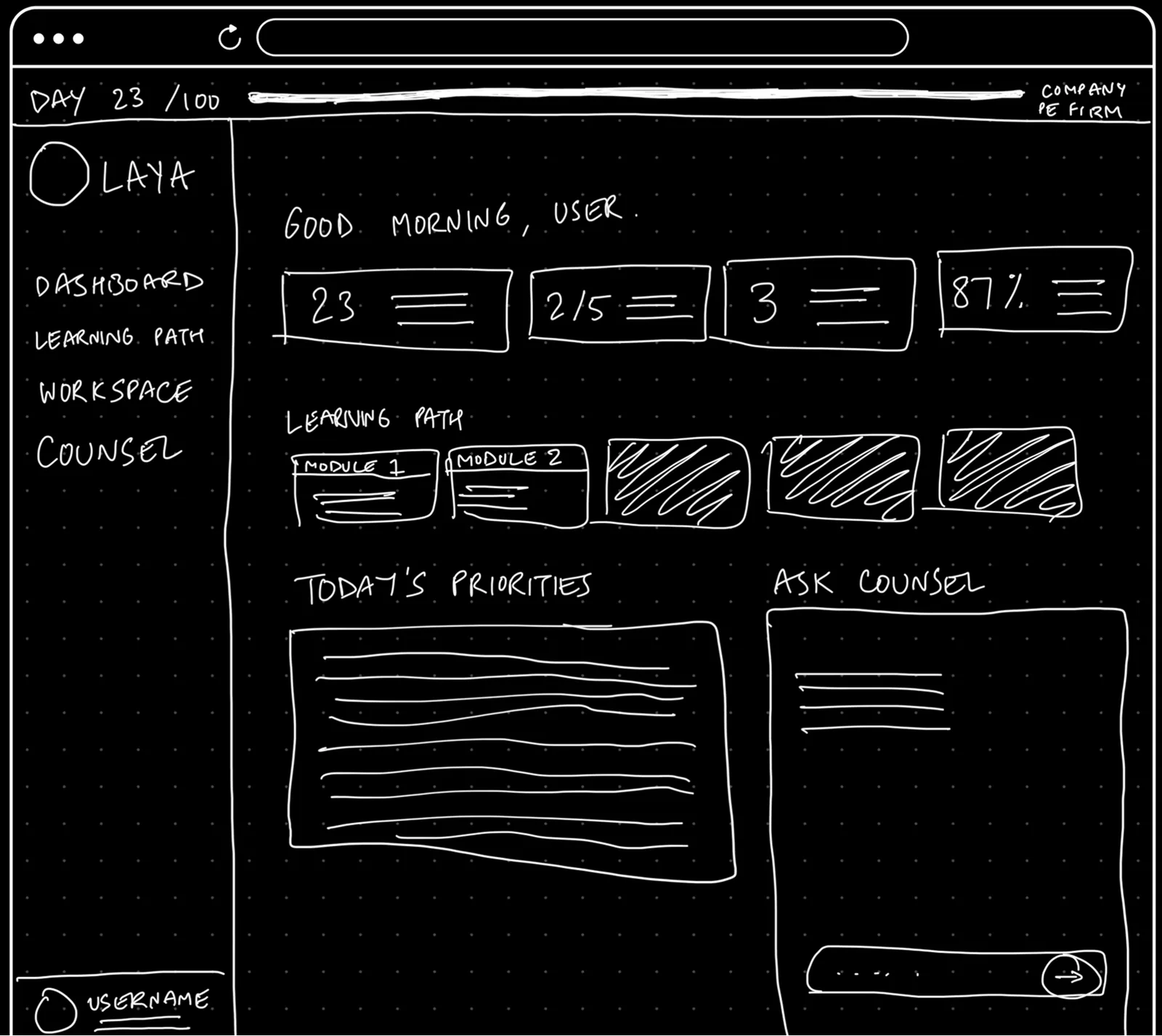
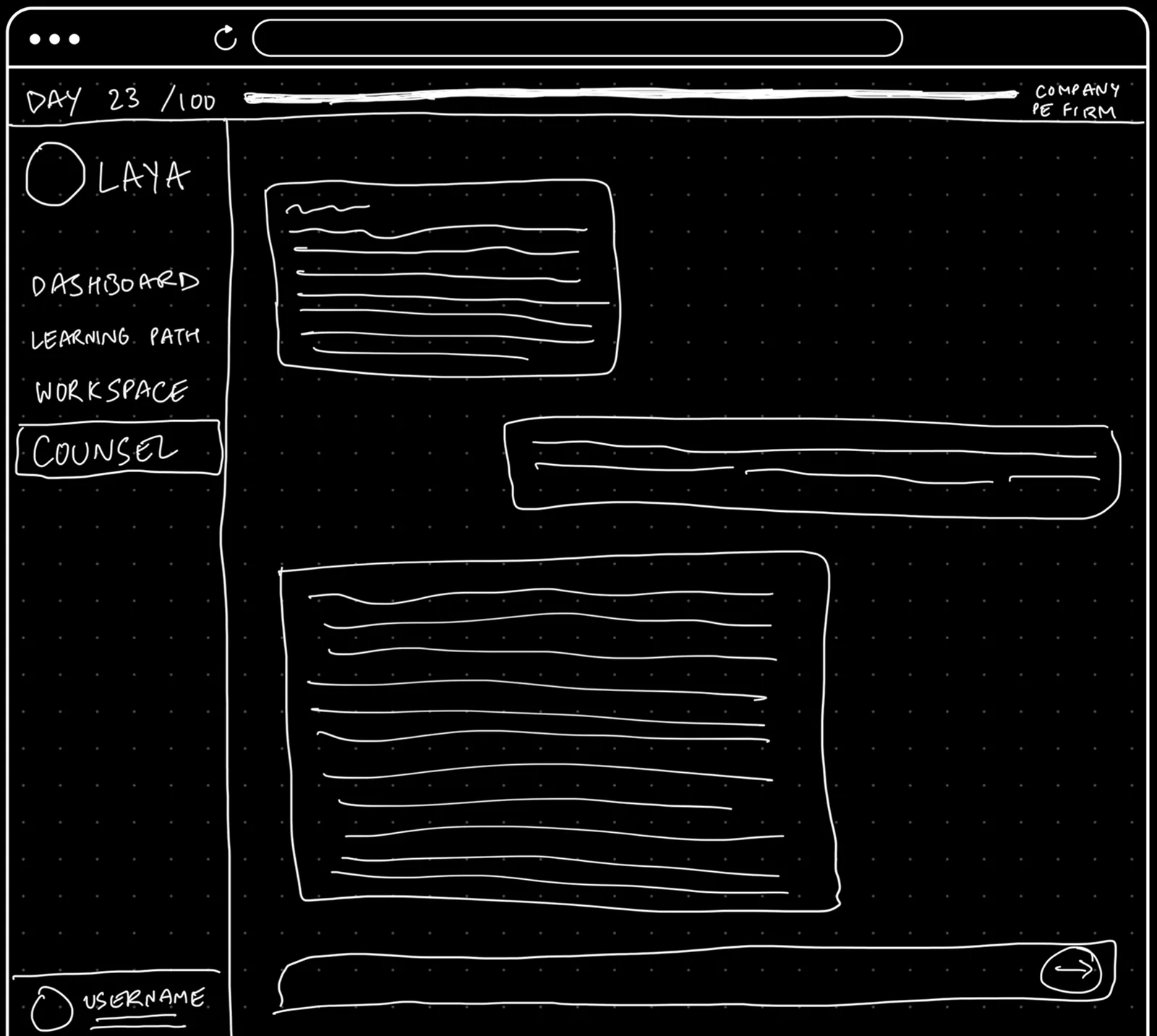
I started by turning the research into a full feature list, then used affinity mapping to sort and group it into clear themes. Those groups became the information architecture behind Laya’s navigation. From there, I mapped the critical task flows a new CEO would move through in the first 100 days, and explored each one in low-fidelity sketches before committing to any screens.

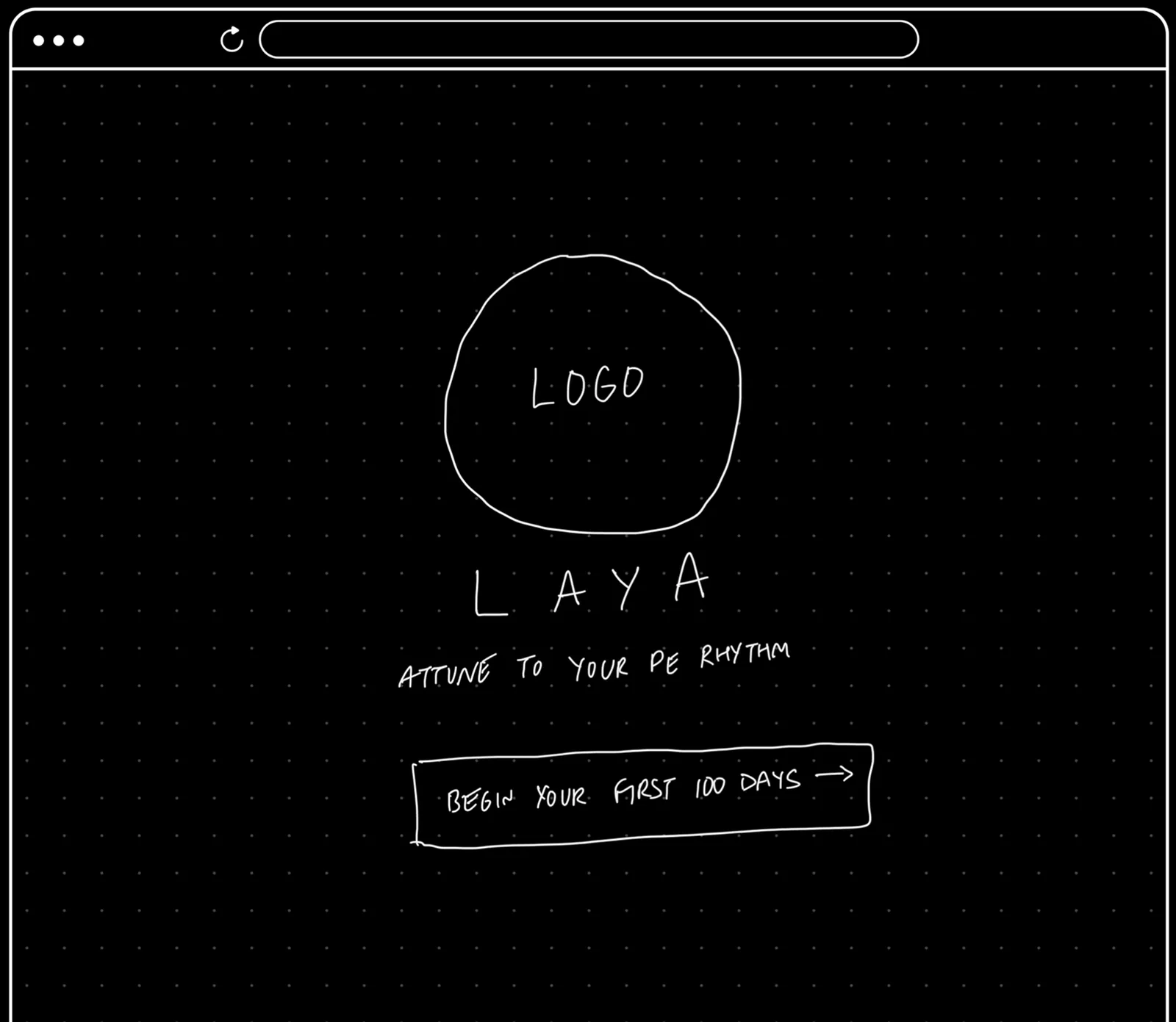
Low-fidelity sketch 01: welcome screen
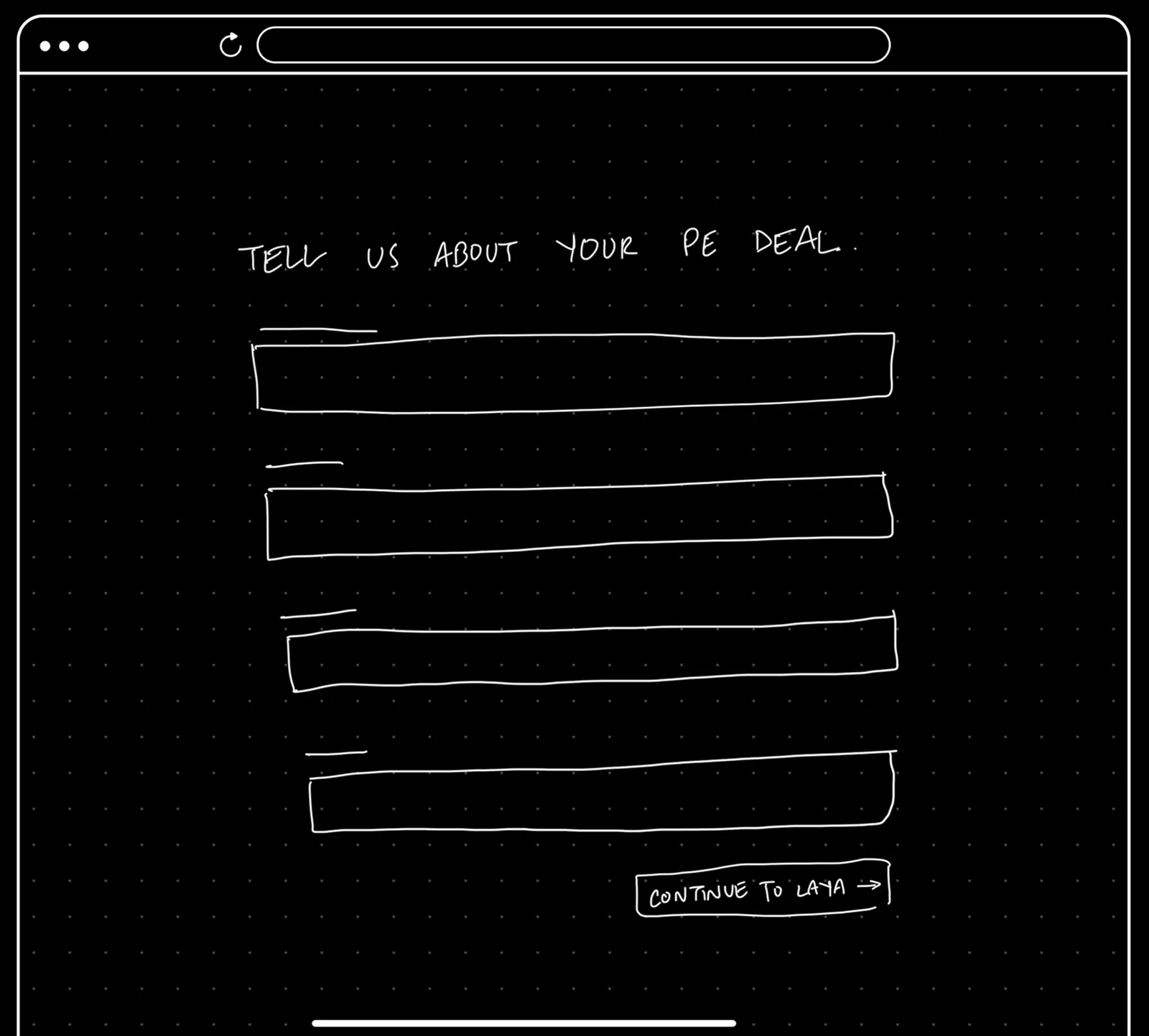
Low-fidelity sketch 03: deal intake form
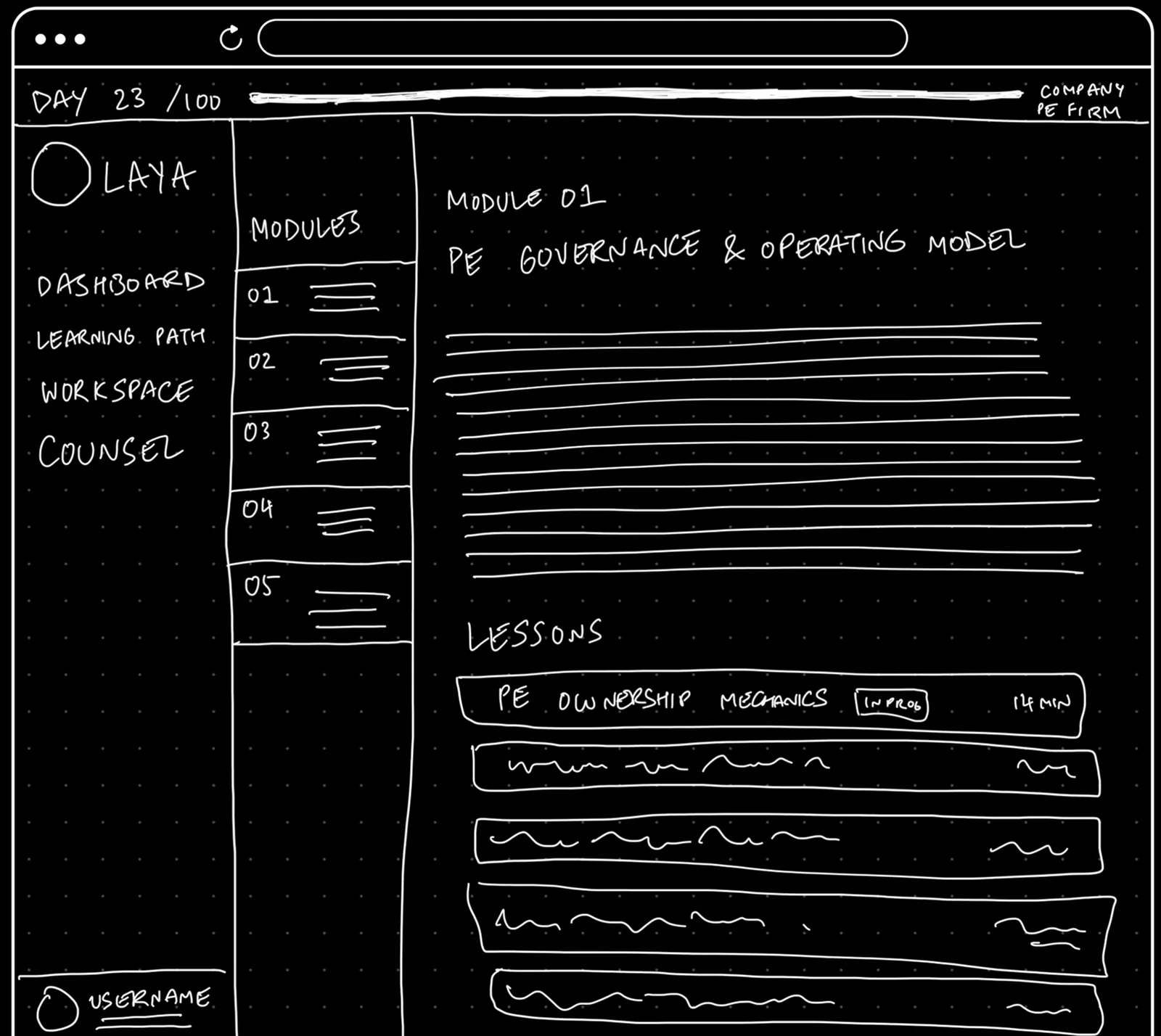
Low-fidelity sketch 05: learning path module on PE governance
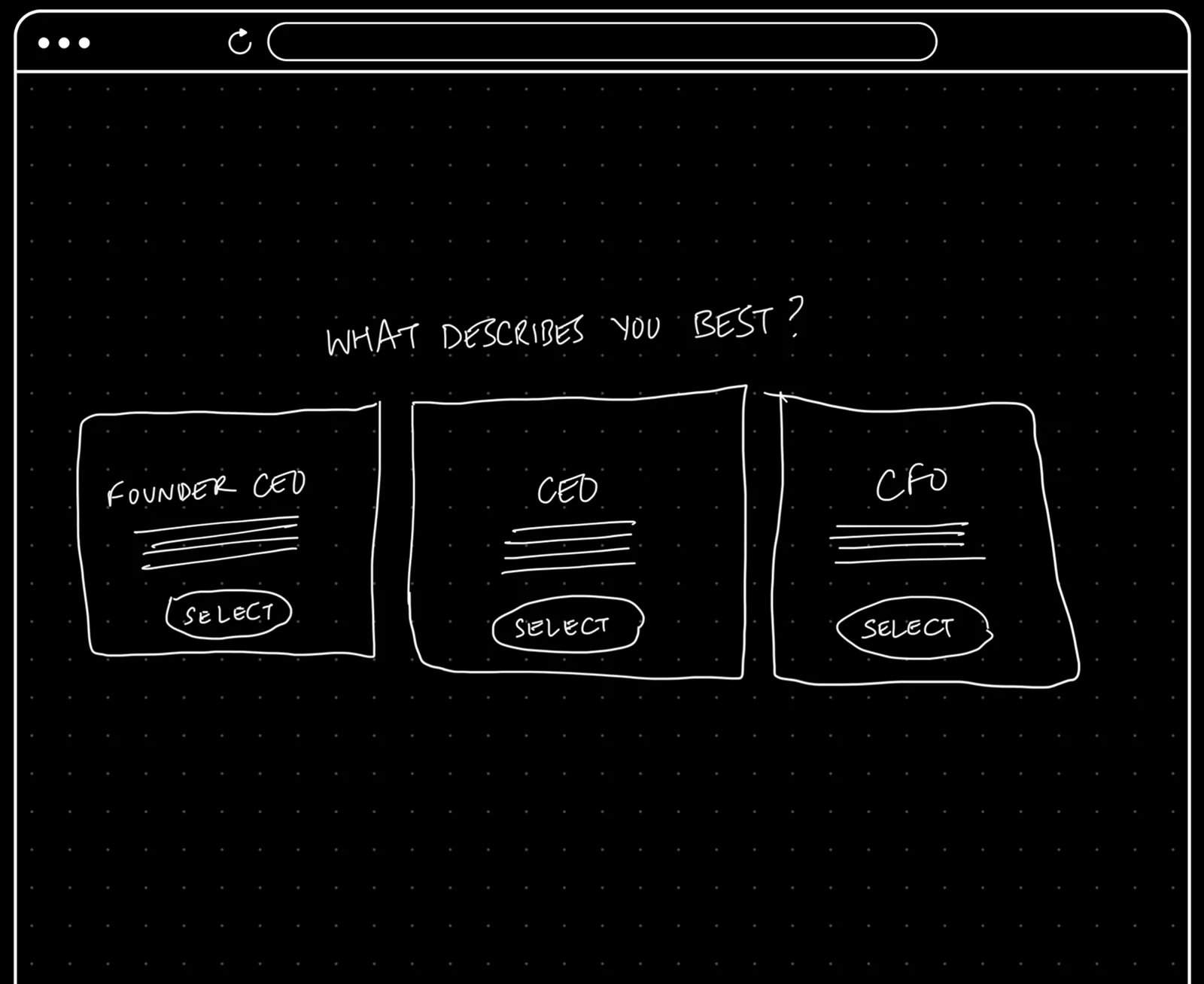
Low-fidelity sketch 02: role selection: founder-CEO, CEO or CFO
Low-fidelity sketch 04: dashboard with today’s priorities and Ask Counsel
Low-fidelity sketch 06: Counsel AI advisor conversation

Feature affinity map

Every feature the platform could have, grouped by theme and sorted by scope and ambition.

Will be implemented into the platform

Onboarding & setup
  • Role-based onboarding path selection
  • Profile & deal intake
  • 100-day clock activation
  • Onboarding splash screen
Dashboard
  • Daily overview
  • Task & priority tracker
  • 100-day progress bar
  • EBITDA progress indicator
  • 100-day governance risk map
Stakeholders
  • Stakeholder map table
  • Stakeholder cadence reminders
  • Private stakeholder notes
Private workspace
  • Business notes editor
  • Note categorization
AI advisor
  • Full-screen Counsel chat
  • Counsel quick panel (dashboard widget)
  • Context-aware responses
VCP tools
  • VCP builder framework
  • 30-60-90 milestone tracker
Learning path
  • 5-module sequential learning path
  • Lesson detail view
  • PE language lexicon
  • Module progress tracking
  • Role-specific learning track
Templates & reference tools
  • Governance decision matrix
  • 100-day review template
  • Board prep scaffolding
  • 13-week cash forecast template

Valuable features worth building if time and scope allow

AI advisor enhancements
  • Board narrative drafting with Counsel
  • Counsel conversation history
  • Proactive Counsel nudges
Enhanced onboarding
  • Cultural onboarding intake
  • Deal document upload & parsing
  • Pre-close onboarding mode
Content & learning
  • Case study library
  • Module bookmarking
  • Communication templates library
Stakeholder intelligence
  • Shadow org map builder
  • Alignment vs. deference tracker
  • Multi-investor conflict flagging
  • Retention risk alerts
  • Stakeholder priority authority layer
Financial tools
  • EBITDA bridge builder
  • Covenant compliance checklist
  • Board signal tracker
  • PE reporting format library
  • Working capital tracker

Stretch features with strong conceptual fit

Collaboration
  • CEO–CFO shared workspace
  • Finance team resource distribution
Advanced analytics
  • Board relationship health score
  • 100-day readiness assessment
  • Decision rights audit log
Advanced AI
  • Counsel voice mode
  • Board pack AI review
  • Document intelligence
  • Personalized risk alerting
Integrations
  • Calendar integration
  • Email summarization
  • Slack/Teams integration
  • Excel/financial model sync
Platform intelligence
  • PE firm-specific onboarding packs
  • Benchmark comparison
  • Repeatable cross-engagement mode
  • Exit narrative builder

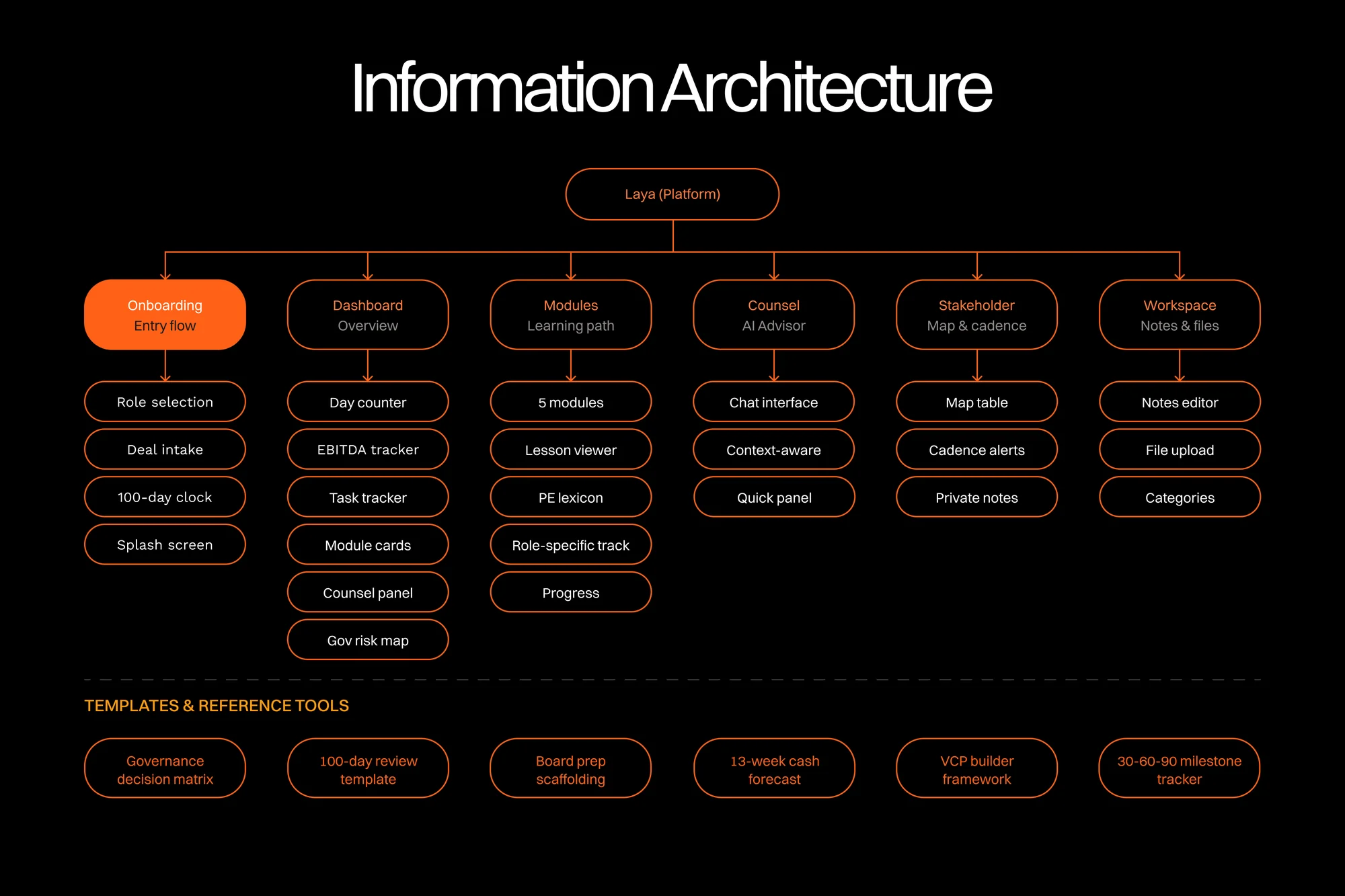
Information architecture

The applicable features, organized into Laya’s six areas plus shared templates and reference tools.

Design system

The visual language behind Laya, from principles and color to the components it’s built from.

Light from darkness

The background is near-black. Orange light radiates from interactive elements only. Every glow is earned by context and function, never decoration.

Warmth over precision

Laya is not a cold institutional tool. Kugile sets the display text, surfaces are brown-black rather than navy, and the platform feels like a trusted presence.

Executive density

Information-rich but never overwhelming. No gamification, no badges, no streaks. Whitespace respects the user’s cognitive load at the highest-pressure moments of their career.

Glow as hierarchy

Level 0 (resting) to Level 4 (hero). Glow shows where the user is in the interaction space. It is never applied to text, and always stays in the orange family.

PrimaryOrange#FF6117
SecondaryAmber#FF9B10
Orange scale
  1. 50#FFDFD1
  2. 100#FFAD87
  3. 200#FF9664
  4. 300#FF7C3F
  5. 400#FF6117
  6. 500#EC4B00
  7. 600#D84500
  8. 700#C13D00
  9. 800#9E3200
Amber scale
  1. 50#FFD69C
  2. 100#FFBB5B
  3. 200#FFB144
  4. 300#FFA62A
  5. 400#FF9B10
  6. 500#E38706
  7. 600#D17A01
  8. 700#B96C00
  9. 800#995900
Semantic colors
  • Success#64C253
  • Danger#E2281B
  • Warning#FAAD1E
  • Neutral#3FA3DF
Personality
AssuredProtectiveElegantWarmIntelligentRefinedStrategicLucidRhythmicSleekEmpatheticGrounded
Concept
A private equity intelligence platform for C-suite executives navigating new PE governance. Two forces finding their rhythm, interlocking into a single, continuous form.
Archetype
The Magician (Carl Jung)
Values
ClarityTransparencyIntegrityTrustMasteryResilienceAuthorityContinuityPrecisionForesightConvictionMomentum
Personality
ComposedUnflappableAttunedDiscerningCandidGroundedPreciseIntuitiveDiscreetPerceptiveDeliberateResonant
Concept
Fuses three symbols into one organic form: the letter C for Counsel; musical notes, honoring Laya, which means “rhythm” in Sanskrit; and the universally recognized star for AI.
Archetype
The Sage (Carl Jung)
Values
WisdomDiscernmentInsightRestraintFidelityPresenceDepthComposureAttunementCandorIntegrityLucidity
Display / headingsKugile

Display · H1 · H2 · Section titles

Body / UISwitzer

Body · Labels · Navigation · UI copy

Data / monoAzeret Mono

Day counters · Metrics · Code · Timestamps

Type scale
display64px · 400 · KugileLaya
h136px · 400 · SwitzerGood morning.
h230px · 500 · SwitzerLearning path
h320px · 500 · SwitzerGovernance decision matrix
body18px · 400 · SwitzerCounsel is your strategic advisor inside Laya.
label15px · 400 · Azeret MonoDECISION RIGHTS
caption14px · 400 · SwitzerLast contact: 3 days ago
mono14px · 400 · Azeret MonoDAY 23 OF 100
Surface tokens
  • Base#0B0B0B
  • Surface#0B0502
  • Raised#0F0602
  • Elevated#120702
  • Overlay#1A0A02
Text tokens
Primary#FFFFFFWCAG AAA · 19.02:1
Secondary#CACACAWCAG AAA · 11.6:1
Tertiary#BABABAWCAG AAA · 9.8:1
Disabled#454545Exempt
Border tokens
  • Subtle#551B00
  • Default#7E2800
  • Active#FF6117
4px base grid
  • space-14px
  • space-28px
  • space-312px
  • space-416px
  • space-624px
  • space-832px
  • space-1248px
  • space-1664px
Border radius
  • xs · 4px
  • sm · 6px
  • md · 8px
  • lg · 12px
  • xl · 16px
  • 2xl · 24px
  • full · full
Glow system

Laya uses warm glow instead of traditional shadows. Glow levels encode hierarchy and interactivity, not decoration, and always use the primary orange #FF6117.

  • Level 0 · RestingNo glow
  • Level 1 · Ambient0 0 18px · .06
  • Level 2 · Hover0 0 28px · .13
  • Level 3 · Active0 0 36px · .22
  • Level 4 · Hero0 0 56px · .38
Buttons
Get started →Begin your 100 daysOpen CounselView moduleContinue to Laya →
Badges and tags
ActiveChampionNeutralRiskDecision riskDay 23 of 100Locked
Input field
Ask Counsel anything…
Do I need approval for this hire?
Module cards
Module 1Founder to PE mindset65% complete
Module 2Talent and people strategyReady to start
Module 3Driving the VCPLocked

04 — Prototyping

The prototype in motion

Prototype

A high-fidelity Figma prototype of Laya’s onboarding experience: how a newly PE-backed leader goes from a first visit to a personalized, governance-ready workspace.

Onboarding walkthrough

Mid-fi wireframing

To reach testable screens faster, I used AI to generate mid-fidelity wireframes from my low-fi sketches and the information architecture, then refined them in Figma. That gave test participants realistic layouts and content to react to before any visual polish went in.

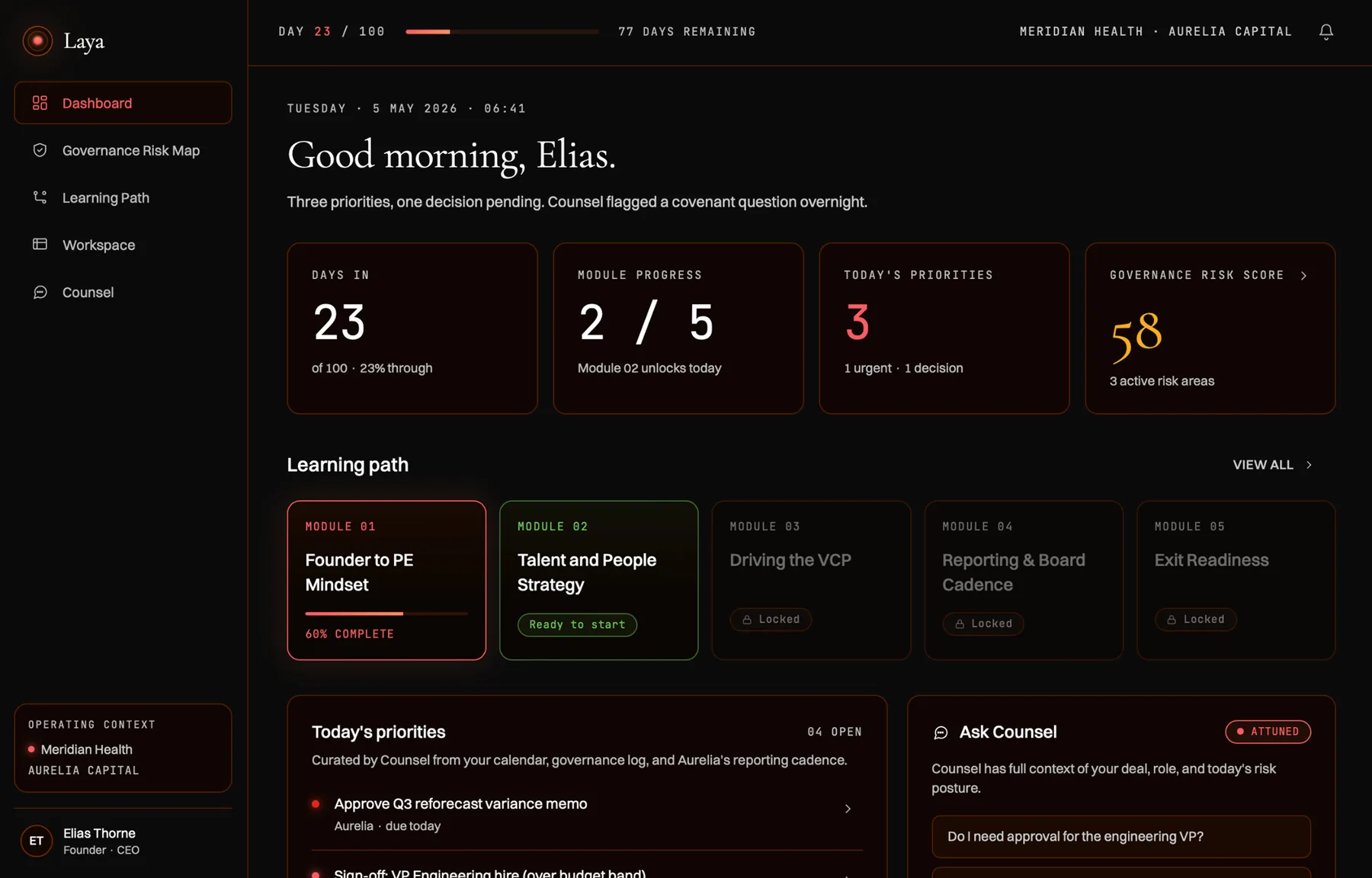
Mid-fi wireframe 01: dashboard greeting Elias with day count, module progress and today’s priorities
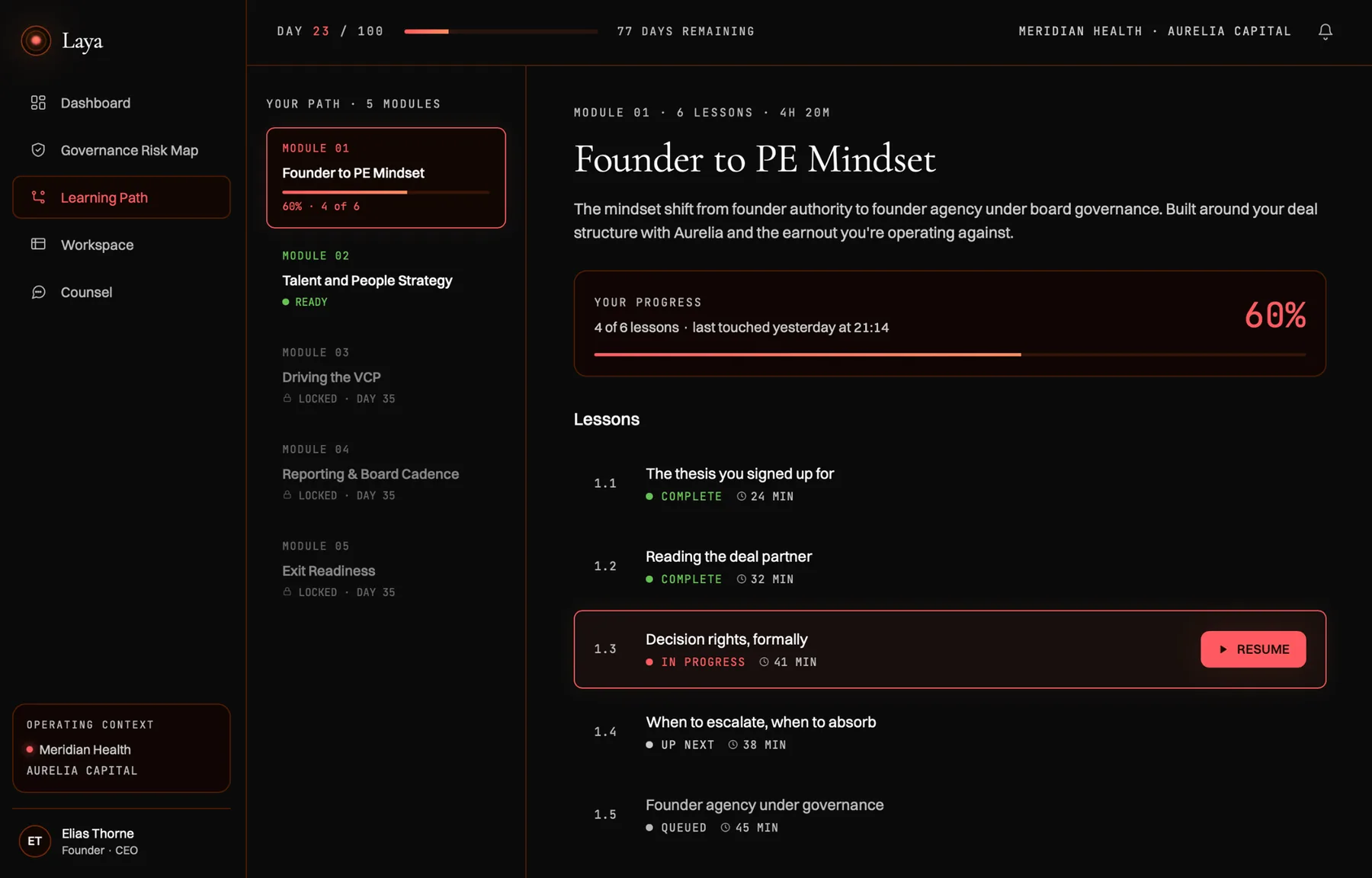
Mid-fi wireframe 03: learning path module, Founder to PE Mindset, with lessons and progress
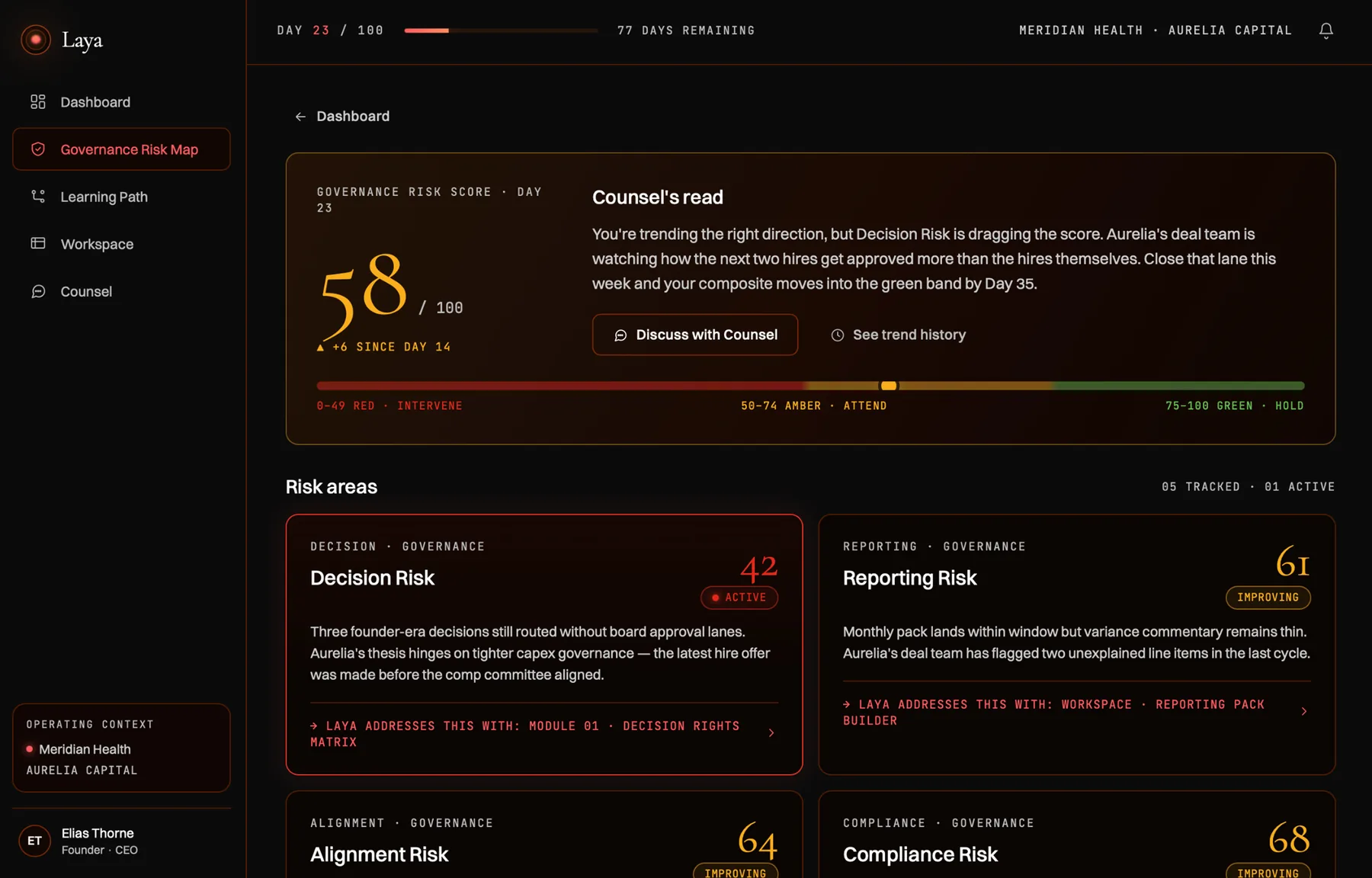
Mid-fi wireframe 02: governance risk map with Counsel’s read and risk areas
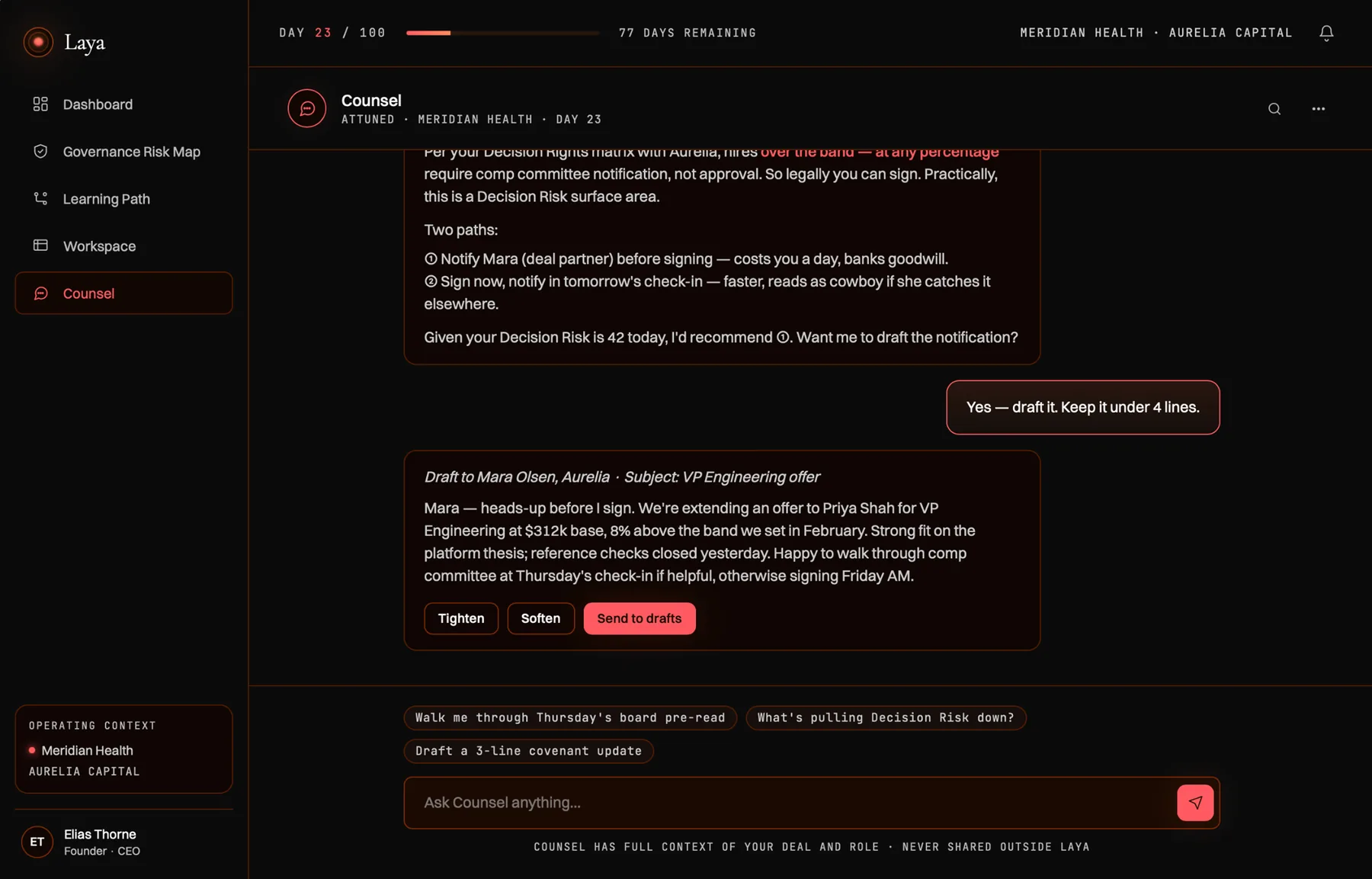
Mid-fi wireframe 04: full-screen Counsel AI advisor conversation

05 — Testing

What testing told us

User testing plan

Three participant groups, each matched to its own testing method, run against four core flows of the prototype.

Tools

  • WhatsApp
  • Google Meet
  • Figma
  • Zoom
  • Claude

Participants and methods

Who
4–7target participants
  • Testing with the direct potential users and the closest available proxies.
  • Evaluates whether Laya’s logic, language and value proposition feel real and credible.
Who to recruit
  • C-suite executives
  • MBA students with finance, strategy or entrepreneurship concentrations
  • Mid-level finance professionals
  • Business school professors who teach PE, corporate governance or strategy
  • Professionals who have worked at a PE-backed company in any senior capacity
  • Entrepreneurs who have gone through an acquisition or investment
How

Moderated usability testing

  • 30–45 min
  • Zoom or in person

I share my screen showing the prototype and ask the participant to narrate their thoughts as they move through each task. I observe without intervening.

After each task, I ask three debrief questions. At the end, I run a five-minute open debrief.

Who
2–4target participants
  • One structured audit session per mentor, using the prototype in its current state.
Who to recruit
  • Existing mentors
  • If possible, one additional mentor from a different background, such as a CFO, an operating partner at a PE firm, or a UX researcher with enterprise product experience
How

Expert audit

  • 30–60 min
  • Guided walkthrough

I walk the mentor through the prototype screen by screen, explaining the intent behind each design decision and asking for their assessment.

I’m not asking them to complete tasks independently. I’m facilitating a structured critique, and I capture their feedback in a written audit document.

Who
4–7target participants
  • No finance or PE background.
  • Classmates, friends, family members: anyone willing to spend time with the prototype.
Who to recruit
  • SCAD classmates from other majors
  • Friends or family members who work in unrelated fields
  • Anyone who has never heard of private equity
How

Moderated think-aloud

  • 20–30 min
  • One-sentence scenario

I give the participant one scenario:

“You are a CEO who just sold your company to a PE firm. You have 30 minutes before your first board meeting. Use Laya.”

Then I watch silently while they navigate, noting every moment of hesitation, misclick, confusion or delight. After the session, I ask five quick questions to debrief.

Testing user flows

Flow 01 · 5 steps

Onboarding to Day 1

  1. Splash screen with slogan and CTA
  2. Role selection screen
  3. Deal intake form
  4. Loading and transition moment
  5. Day 1 dashboard loads
Mid-fi wireframe: Day 1 dashboard
Flow 02 · 6 steps

Ask Counsel a question

  1. On the dashboard, today’s priorities read: “Confirm VP Engineering hire. Decision pending.”
  2. Opens the Counsel quick panel: “Do I need board approval to hire a VP of Engineering at $180K?”
  3. Counsel responds with a short answer and a “Continue in Counsel” prompt
  4. Taps through to full-screen Counsel
  5. Counsel responds with a structured answer
  6. Returns to the dashboard
Mid-fi wireframe: Full-screen Counsel conversation
Flow 03 · 5 steps

Governance risk map

  1. Observes the Governance Risk Score on the dashboard
  2. Clicks the score, or “Governance Risk Map” in the nav bar
  3. Views Counsel’s contextual summary
  4. Views the score breakdown
  5. Goes back to the dashboard
Mid-fi wireframe: Governance risk map
Flow 04 · 5 steps

Learning path

  1. On the dashboard, views the module cards or opens “Learning Path” in the nav bar
  2. Opens the Learning Path tab
  3. Views Module 1, Lesson 1
  4. Marks it as complete
  5. Goes to the next lesson
Mid-fi wireframe: Learning path module

What testing revealed

Seven participants across three groups, including three expert audits, worked through the four core flows. The clearest pattern: early Laya communicated volume before value. Participants wanted the platform to open with a directive, not a status report, and that reshaped the dashboard into an advisory briefing.

7participants across 3 testing groups, including 3 expert audits
71%chose the orange nav CTA over the dark centered button on the landing screen
86%skipped the document upload when meeting Counsel; the privacy promise was buried
14 → 4Day 1 priority tasks after testing showed 14 signaled volume, not priority

On the redesigned dashboard

“The subtitle makes Counsel feel like something that was working while I slept. That is the difference between a tool and an advisor.”

On sharing documents with Counsel

“These are incredibly sensitive documents. Where exactly are they going? Who sees them? … I want that front and center before I drag anything into that box.”

06 — Solution

A briefing, not a dashboard

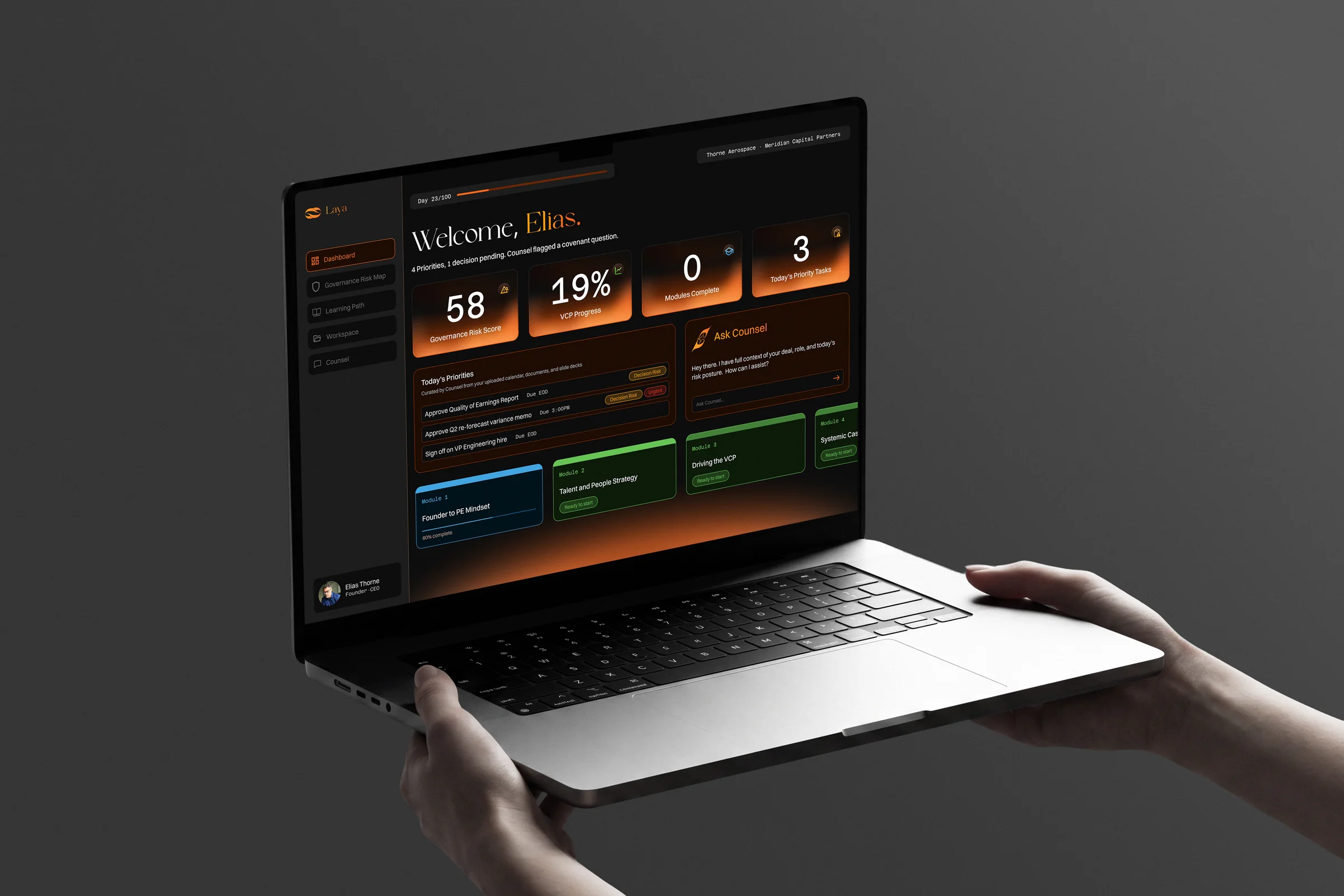
Final Laya dashboard on a laptop held in two hands: Welcome, Elias, with governance risk score 58, VCP progress 19%, 3 priority tasks, Today’s Priorities and Ask Counsel

A dashboard that opens with a directive

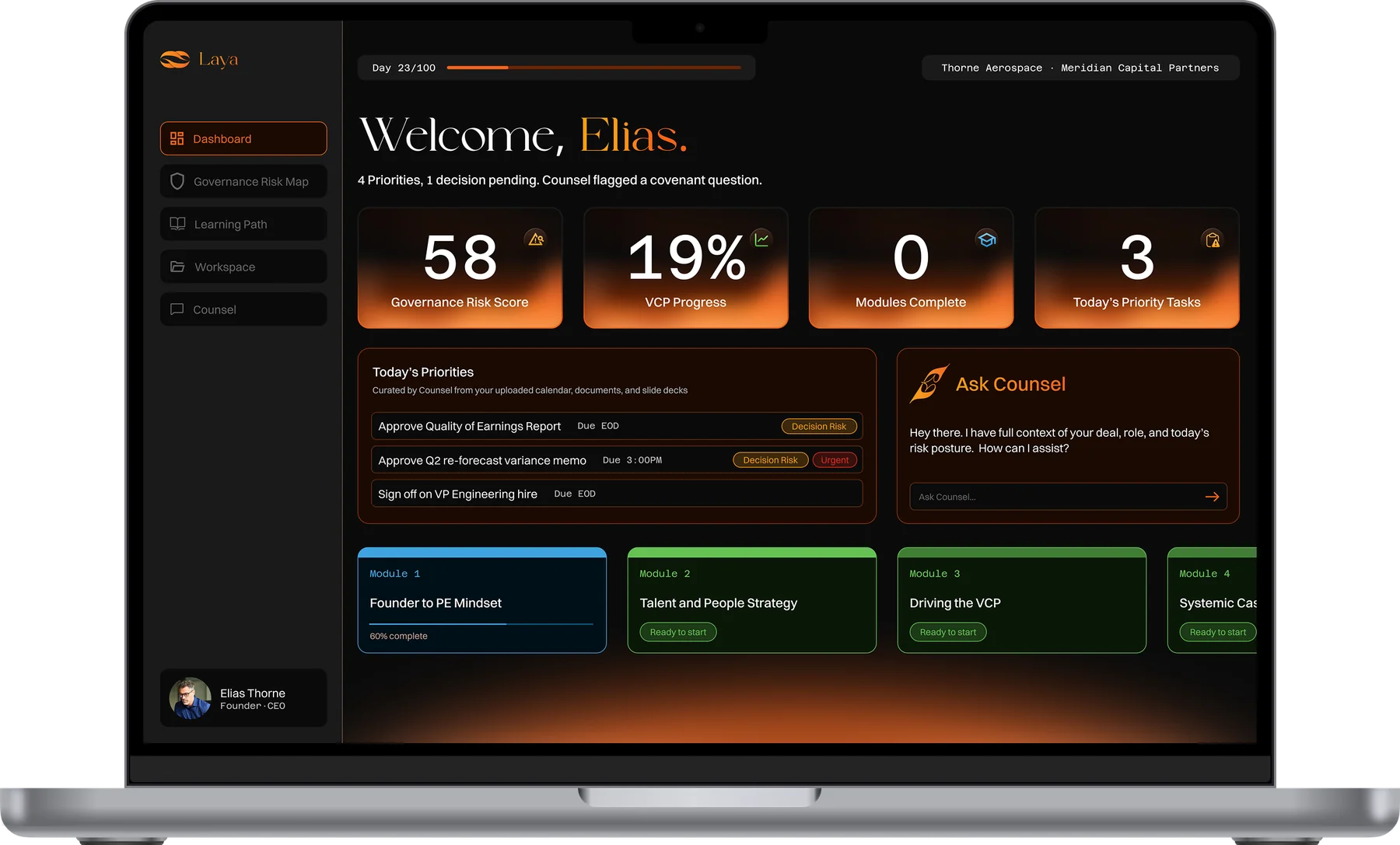
Each morning starts with a greeting and one line of real-time context: how many priorities, which decision is pending, what Counsel flagged overnight. Today’s Priorities shows only what is actionable that day, set against the 100-day clock.

Counsel, an advisor that knows your deal

Counsel is calibrated to the leader’s own board, covenants, earnout and 100-day window, so its answers come in context, not as generic advice. Shared deal documents stay private; the PE firm never sees them.

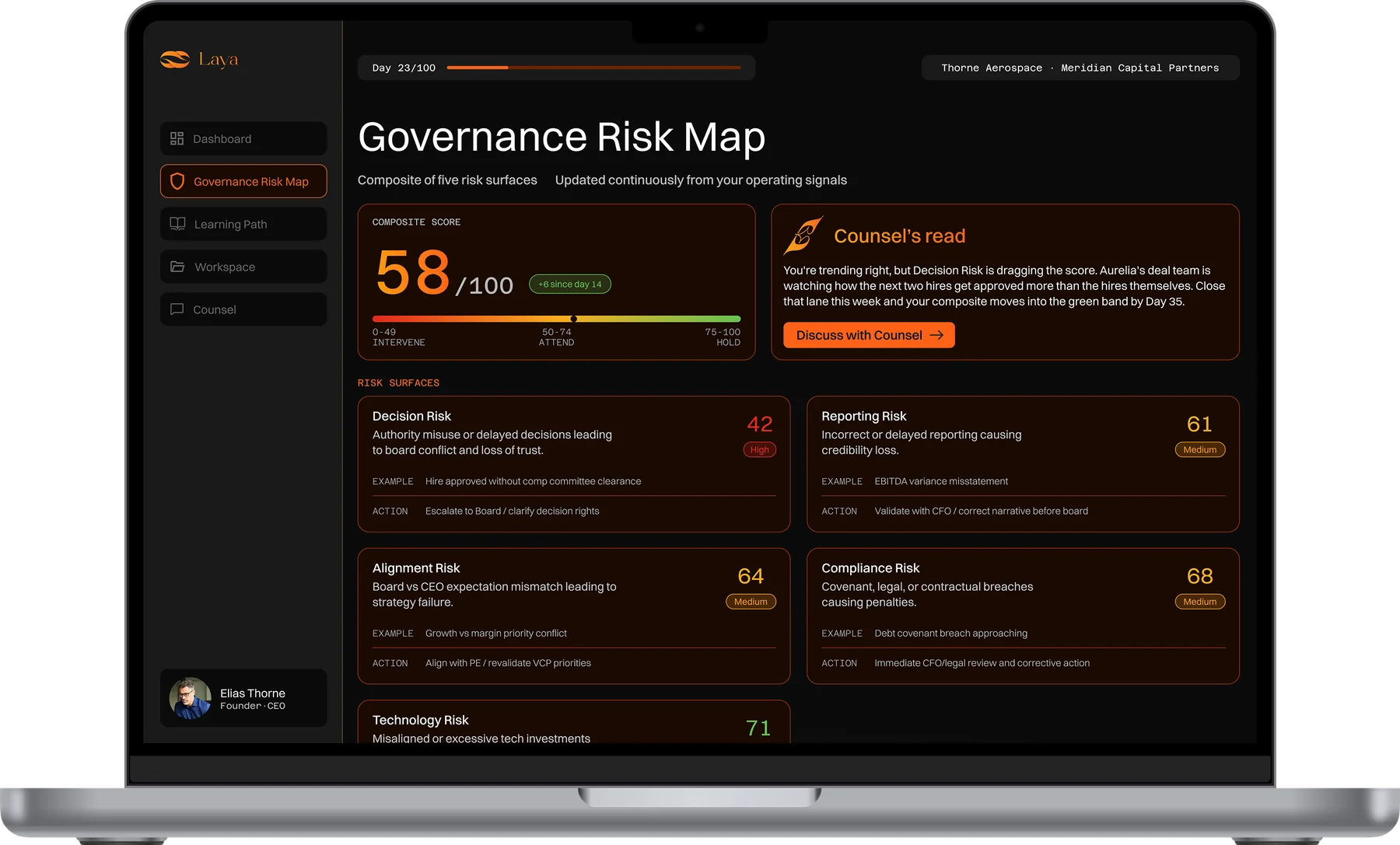
Governance risk map

A single governance score, banded red, amber or green, breaks down into the risk areas behind it. Counsel explains what is moving the score, and each risk links straight to the module or tool that addresses it.

Prototype walkthrough

Every screen, start to finish

From the dashboard to Counsel’s chat window, here is each LAYA screen in action.

Laya dashboard screen on a laptop
01

Dashboard

Where every session begins once onboarding is complete. Metrics, priorities and modules are calibrated to the leader’s onboarding answers and shared deal documents, making the dashboard the hub for everything Laya does.

Laya governance risk map screen on a laptop
02

Governance risk map

A composite score for the overall health of the deal and its progress against the value creation plan. It draws on five categories (decision, reporting, alignment, compliance and technology risk) and updates continuously from operating signals. Counsel can break down what is driving the score and how to bring the risk down.

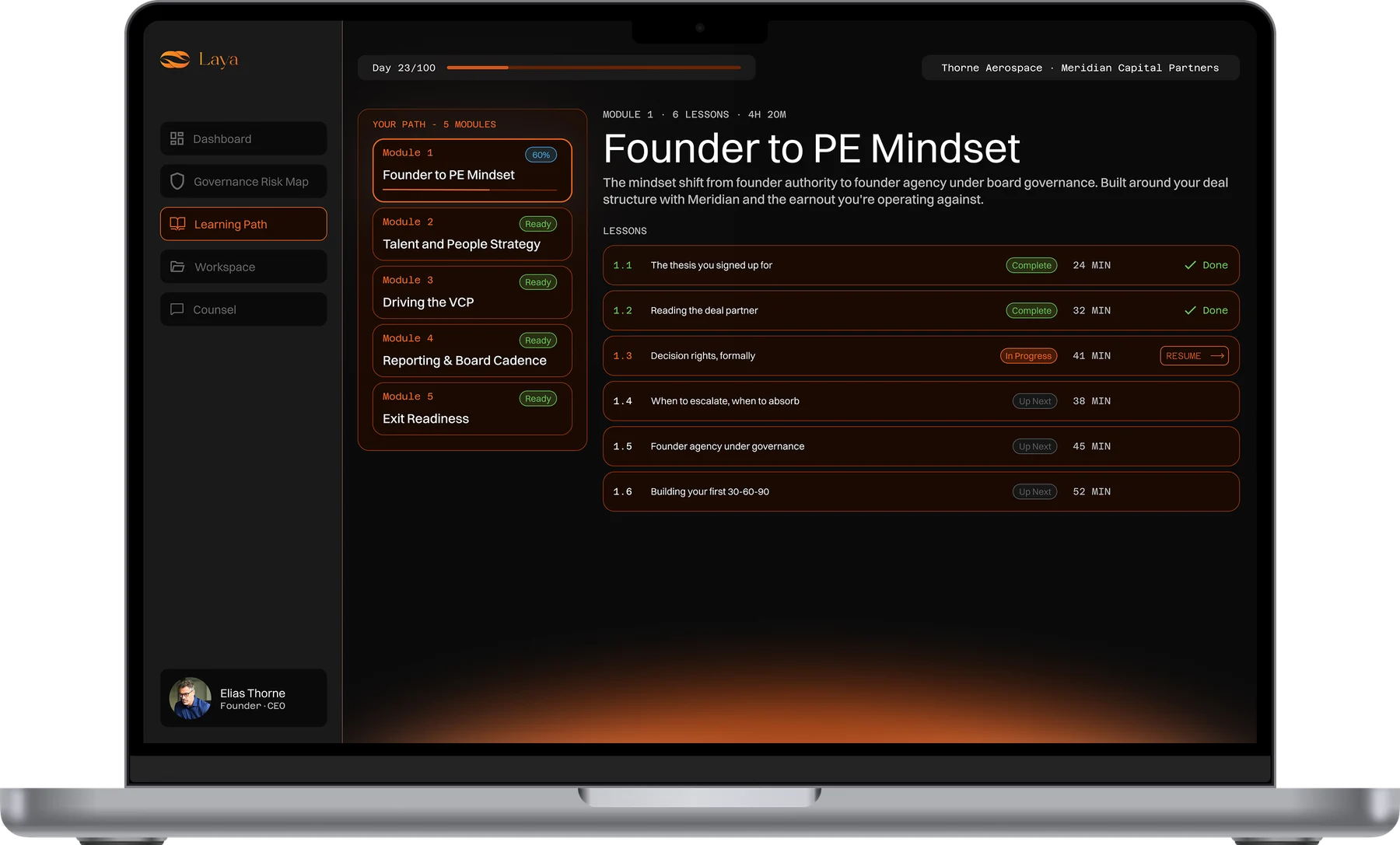
Laya learning path screen on a laptop
03

Learning path

The learning hub that prepares leaders with the private equity knowledge the role demands, through modules ranging from Founder to PE Mindset to Driving the VCP.

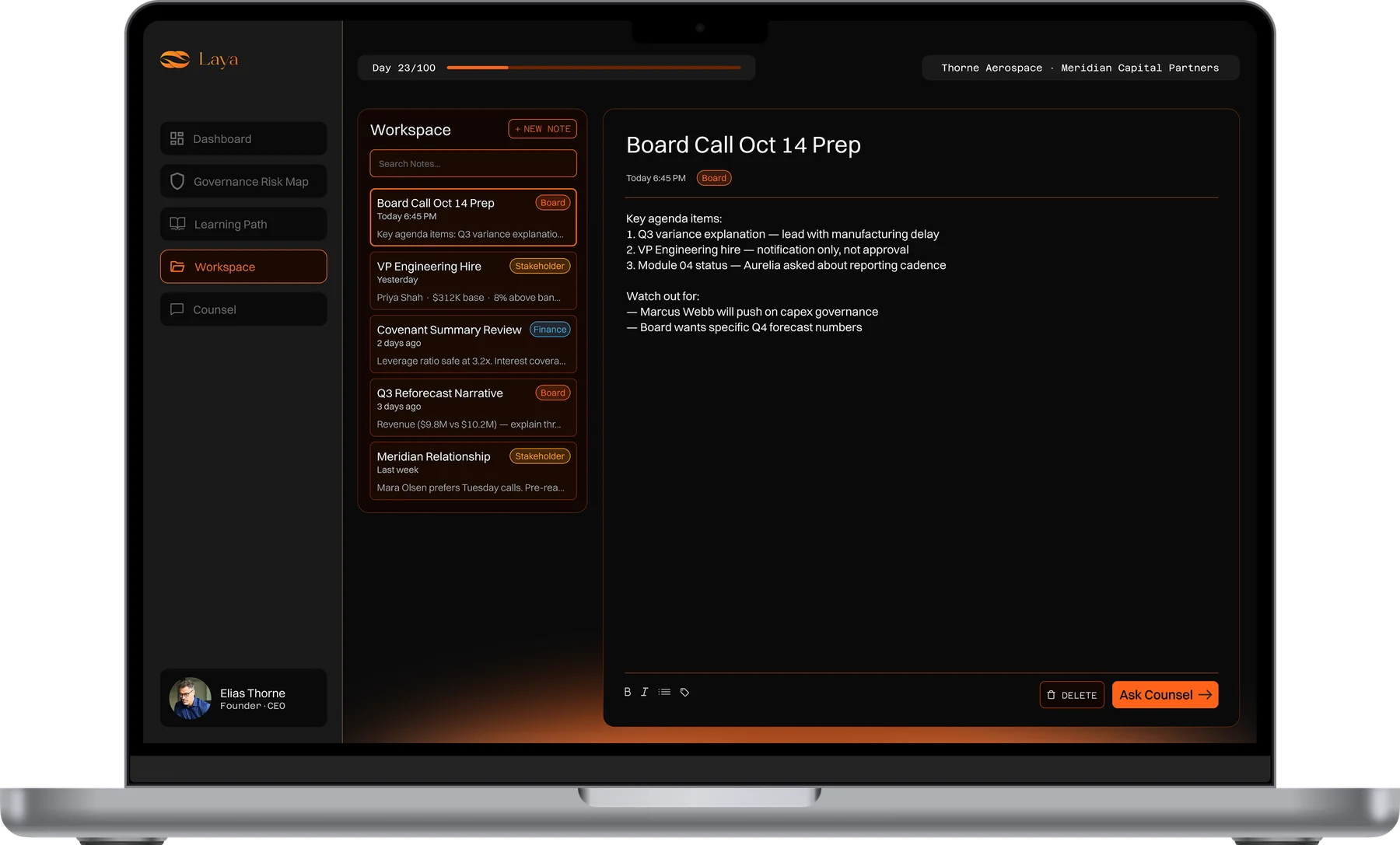
Laya workspace screen on a laptop
04

Workspace

A private space for the leader’s files and notes. Counsel draws on what is stored here when it builds the governance risk map and answers questions, so its guidance reflects the leader’s real situation.

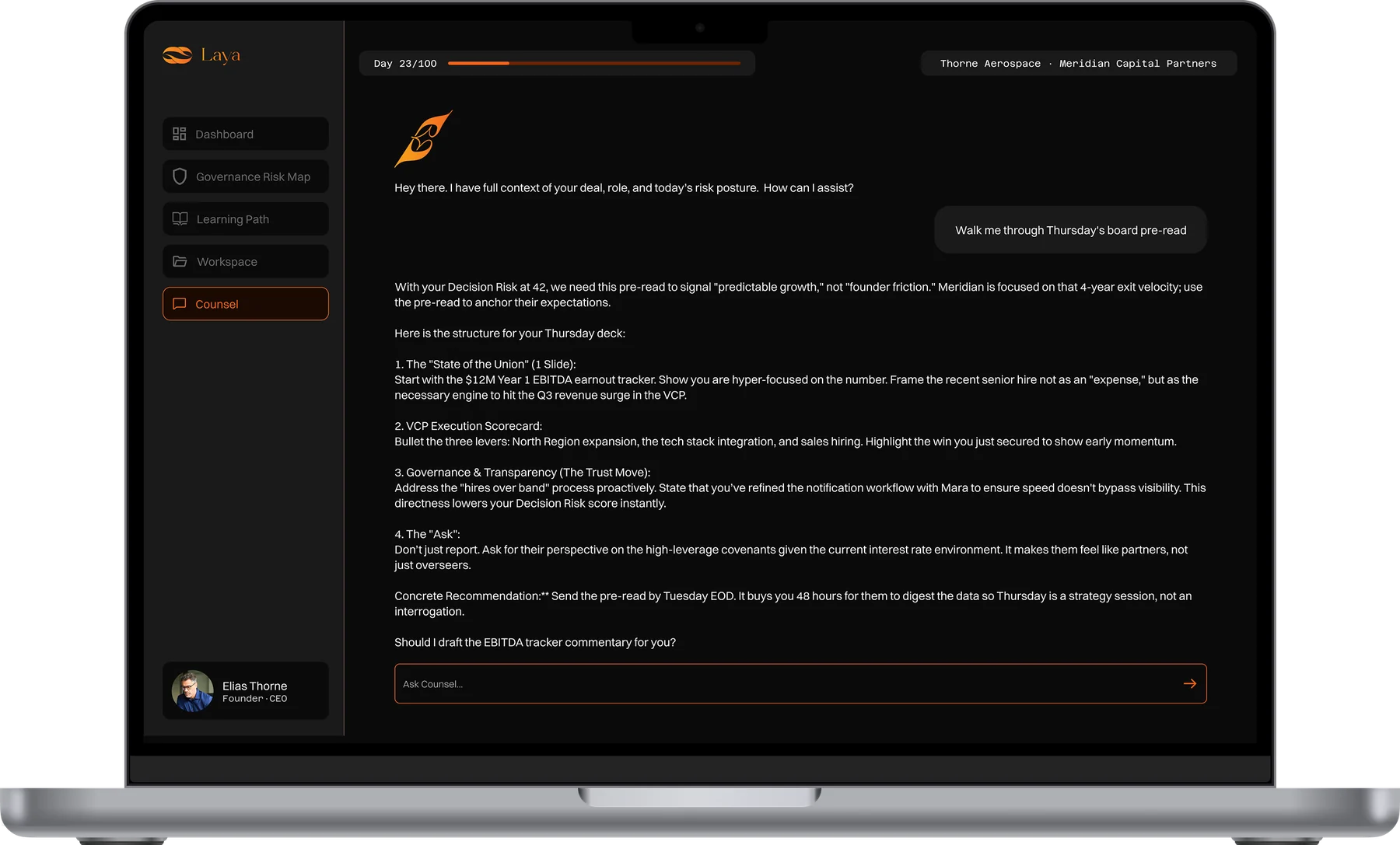
Laya counsel screen on a laptop
05

Counsel

The AI advisor’s full chat window. Leaders can ask Counsel anything about private equity or their deal and get answers that are instant, thorough and concise.

07 — Reflection

What I’d carry forward

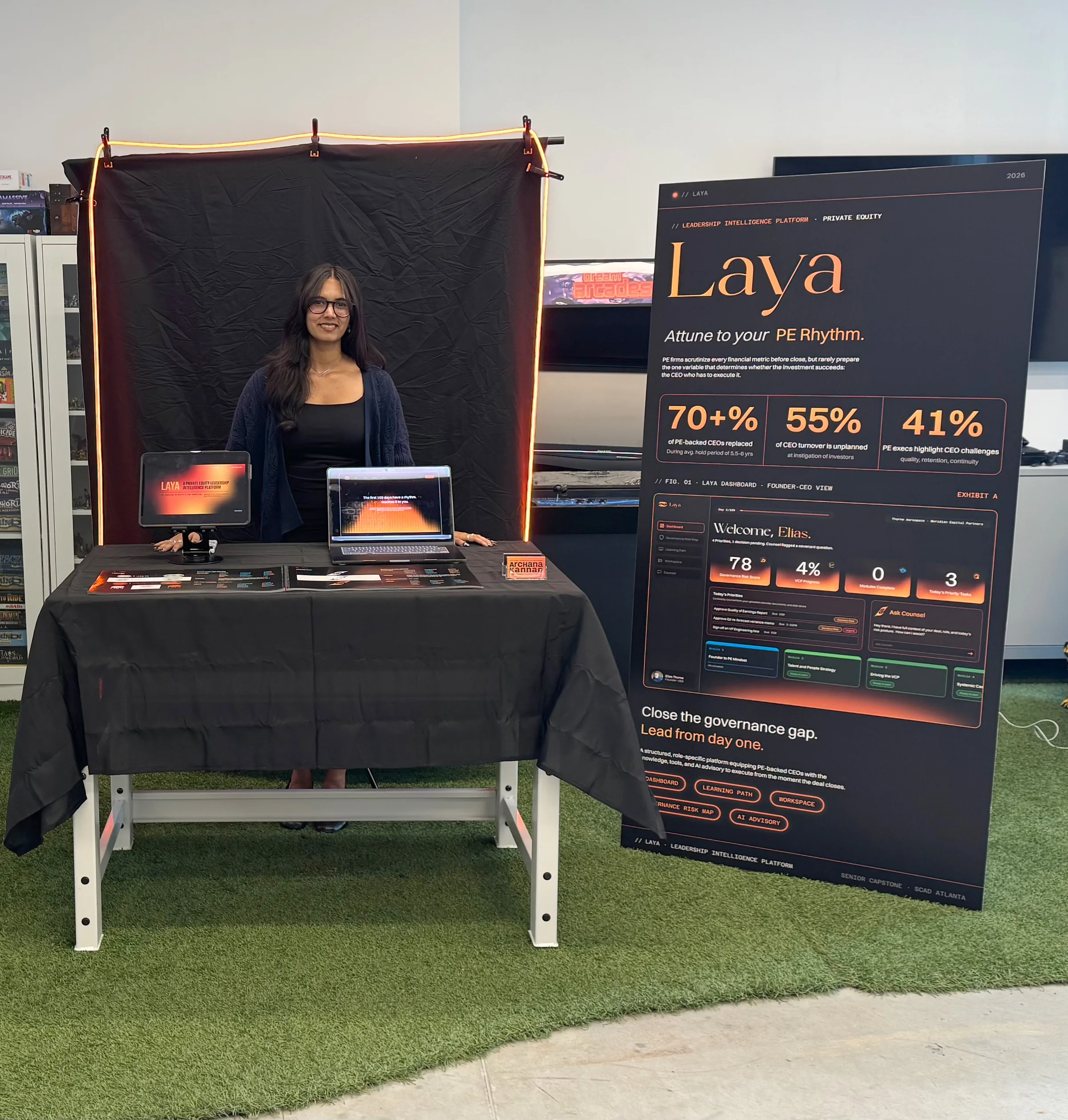
Archana at her Laya showcase booth: a table with a tablet and laptop running Laya, beside a tall Laya poster reading Attune to your PE rhythm
Presenting Laya at the SCAD senior capstone showcase

The discomfort was intentional. The growth was the goal.

Laya was a deliberate choice. Private equity is complex, high-stakes and completely outside my prior experience, and that was the point. I wanted to push into territory I had never designed for, where the domain demanded mastery before the design could begin. My SCADpro work with Deloitte and UBS gave me a foundation in enterprise environments and financial services culture, but Laya asked me to go further.

A capstone also gave me free rein to experiment, and I used it. I didn’t want Laya to look like the typical corporate software these leaders already use every day, so I gave it an immersive, cinematic feel: a product that earns attention, not one that blends into the stack.